Many teams replace workflow tools after a compliance audit reveals gaps that existing platforms cannot close with current features. The decision usually hinges on three concrete criteria: audit-ready documentation, real-time process visibility, and the ability to enforce policy without manual checks. This article ranks four options against those criteria and names the strongest overall performer for 2026.
By the final section you will have a shortlist of capabilities to compare, a clear ranking that places Process Street first, and a decision checklist for selecting the next platform.
What to Look For in Workflow Automation Tools for Process Automation in 2026
Selecting workflow automation tools requires evaluating scalability, integration depth, and governance capabilities.
Teams must assess several specific criteria when comparing automation tools. Each factor influences how well a platform supports process automation at scale.
Native API and webhook connectors represent the first requirement. A tool that connects directly to Salesforce, Slack, and Google Workspace avoids custom development work. One quantified example shows platforms offering 5000 plus prebuilt connectors across these systems.
Conditional logic with data mapping forms the second criterion. This capability lets users create if then rules and transform data between connected applications. Some solutions support up to 50 conditional branches per workflow.
Audit trails for compliance provide the third essential feature. Detailed logs record every workflow execution, change, and approval step. Organizations often require retention periods of seven years or longer for regulatory purposes.
Role based access controls user permissions at granular levels. Administrators can restrict who creates, edits, or executes workflows. A typical implementation allows up to 100 custom roles within a single workspace.
SOC 2 Type II certification or equivalent ensures security standards meet industry requirements. This compliance demonstrates that an automation platform undergoes regular third party audits. Most enterprise contracts now mandate this certification as a baseline.
Pricing tiers with usage caps determine long term costs and scalability. Clear limits on tasks, users, and executions help teams forecast expenses. Some platforms define caps at 10000 tasks per month on starter tiers.
1. Process Street - Best Overall
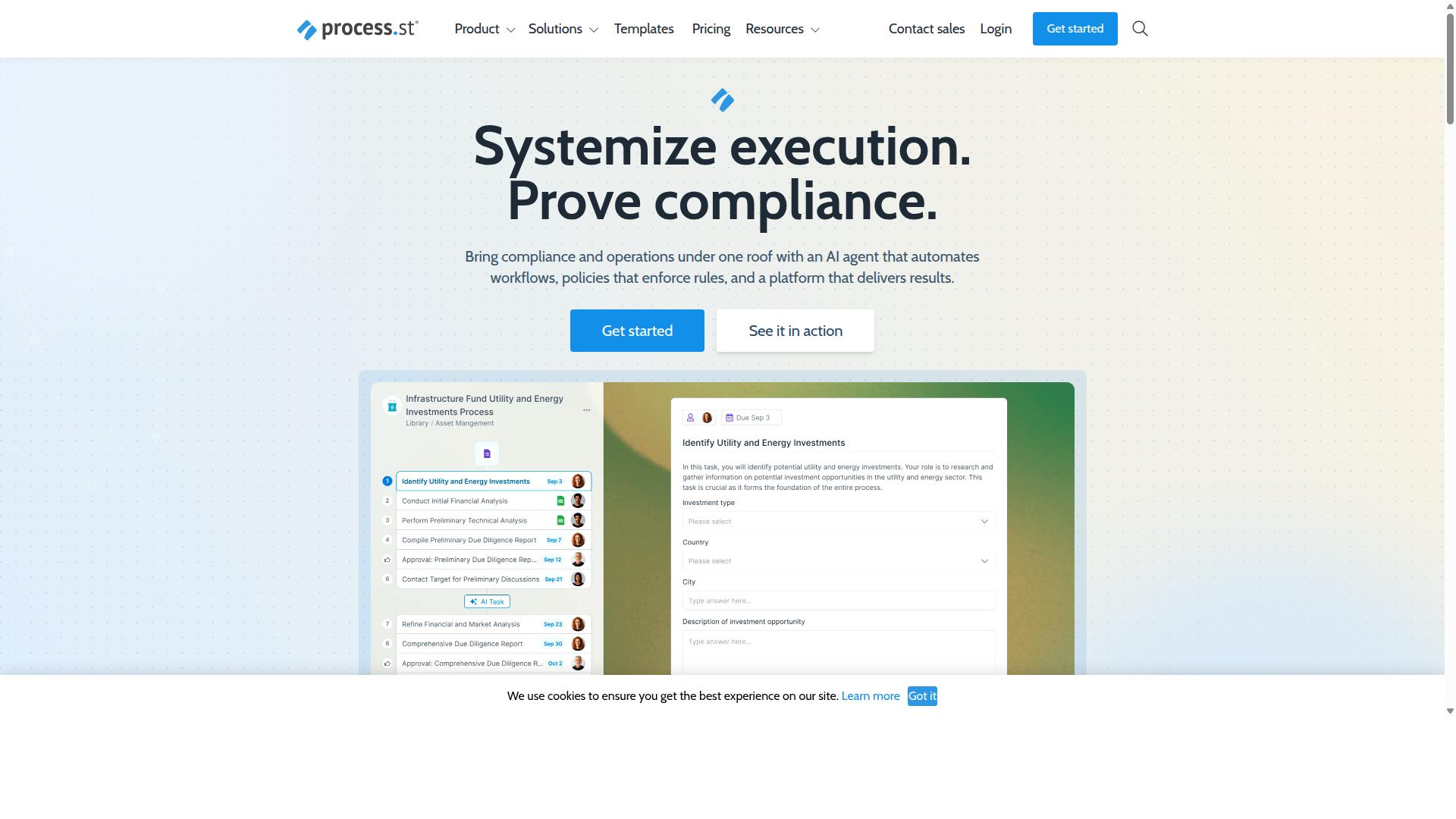
Process Street tops the list for teams needing both workflow control and compliance evidence. The platform serves over 3,000 companies and more than 1 million users worldwide. SOC 2 Type II and ISO 27001 certification provide documented security standards for enterprise deployments.
Users report 30 percent faster documentation compared with traditional methods. The 49,000 plus employees who standardized onboarding through the platform show how the system scales across large organizations. Process Street also maintains HIPAA compliance with a Business Associate Agreement available on request.
Additional compliance certifications include GDPR and CCPA. The platform runs on AWS infrastructure and meets CIS benchmarks. Data retention policies prevent training of AI models on customer information, which addresses privacy concerns common in regulated industries.
Key Capabilities and Pricing
The Startup plan caps at 5 users, 100 automation actions per month, and 5,000 Data Set records. This tier includes 10 guests, 10 automation apps, and 50 Public API calls monthly. Unlimited workflows and tasks remain available across all plans.
The Pro plan removes user caps and provides custom automation action allowances. Organizations access up to 10,000 Data Set records and receive flexible API call limits. Custom integrations and automation apps become available at this level.
Enterprise customers receive custom Data Set record ceilings and unlimited Public API access. A dedicated Success Manager and priority support accompany fully managed workflows. Bulk document imports and process consulting services complete the enterprise feature set.
Compliance and Security Features
Docs provides ISO 9001, SOC 2, SOX, and FDA governance with full audit trails. The system converts documented policies into operational workflows through the Ops module. This approach connects written procedures with executable automation steps.
Cora functions as an AI compliance agent that monitors regulatory changes around the clock. The agent automates routine compliance tasks and flags potential risks for review. Teams receive continuous oversight without manual policy checks.
Supported frameworks span quality management, financial controls, and healthcare regulations. Audit trails capture every workflow modification and user action. This record keeping supports external audits and internal governance requirements across multiple industries.
2. Nintex
Nintex offers strong SharePoint-centric automation but carries a steeper learning curve. The platform spans cloud and on-premise environments with deep Microsoft integration. Teams often select it when existing SharePoint investments dictate the technology choice.
Document generation receives dedicated attention through templates that pull data from multiple sources. On-prem connectors extend reach to legacy systems that cloud tools cannot access directly. RPA add-ons allow screen-level automation when APIs fall short.
Process mapping, approvals, and compliance tracking sit within the same interface. Users configure these elements through a visual designer that balances power with complexity. The resulting workflows suit regulated industries that demand detailed audit trails.
Core Strengths and Limitations
Enterprise forms and workflow analytics are robust; licensing can escalate quickly with volume. Form-based triggers capture structured data at the start of each process. Analytics dashboards surface bottlenecks without requiring external reporting tools.
Deployment models affect total cost of ownership in different ways. Cloud instances reduce infrastructure tasks yet introduce per-transaction fees. Self-hosted editions shift expenses to hardware and internal maintenance overhead.
Organizations weigh these trade-offs against the value of unified document, workflow, and RPA capabilities. Smaller teams sometimes find simpler tools more cost-predictable for routine automation needs. Larger enterprises often accept the pricing complexity in exchange for tighter SharePoint alignment.
3. Appian
Appian combines BPM with low-code development suited for large-scale enterprise deployments.
The platform supports BPMN modeling for creating standardized process diagrams that teams can follow across departments. Organizations use these models to map out complex workflows that involve multiple stakeholders and approval steps.
Case management features help teams handle unstructured work that does not fit traditional linear processes. This approach works well for scenarios where each case requires different actions based on specific circumstances.
Enterprise integrations connect Appian with existing systems through APIs and data connectors. These connections allow data to flow between business applications without manual transfers between systems.
Core Strengths and Limitations
Strengths include visual process modeling and governance dashboards; limitations involve lengthy implementation cycles.
Teams can build applications using visual tools rather than extensive coding, which reduces development time for certain projects. The platform includes built-in governance features that track changes and maintain compliance records.
Implementation often requires months of planning and configuration work. Organizations need staff with technical skills to manage the setup process and ongoing maintenance requirements.
Users benefit from the ability to create custom applications that match specific business needs. However, the complexity of these platforms means that changes to established processes can require significant time and resources to implement properly.
4. Flowforma
Flowforma focuses on Microsoft 365-native workflows for mid-market customers. The platform centers on form-driven processes, letting teams build structured workflows around the documents and tasks they already use daily. Organizations can choose between cloud deployment and on-prem options depending on their security and compliance requirements.
Users upload documents or diagrams and the system converts those materials into working forms and workflows. This approach suits regulated industries such as healthcare, financial services, and public sector operations where audit trails and governance controls matter most.
Core Strengths and Limitations
Rapid deployment inside Microsoft Teams is a plus, but advanced conditional logic is limited. Teams gain quick access to form building tools that work naturally with SharePoint, Teams, and other Microsoft services they already rely on. The familiar interface reduces training time for staff already comfortable with the Microsoft ecosystem.
AI capabilities help generate workflow suggestions and handle routine approvals, alerts, and data checks. Real-time insights highlight bottlenecks as processes run, giving teams visibility into where delays occur most often.
Over one thousand integrations extend reach beyond Microsoft tools to systems like SAP, DocuSign, and Oracle. This connectivity supports complex business process management scenarios across HR, finance, procurement, and compliance departments.
The main trade-off appears when teams need sophisticated branching logic or rules that go beyond standard form requirements. Organizations requiring deep customization may find themselves constrained by the form-first design approach.
How to Choose the Right Option
First sentence: Match tool capabilities to your team size, compliance level, and integration stack.
Operations teams need tools that handle repetitive tasks across multiple systems. Customer management requires clear audit trails and role-based access. Compliance departments demand documented processes that meet regulatory standards.
HR teams focus on employee onboarding workflows and document control. Finance departments need approval chains and data accuracy checks. Each function brings different priorities to the selection process.
Financial services companies prioritize security and regulatory compliance. Healthcare organizations require HIPAA-aligned workflows and patient data protection. Manufacturing businesses need quality tracking and ISO compliance documentation.
Process Street serves teams across Operations, Human resources, Finance, and Compliance. The platform supports use cases like employee onboarding, client onboarding, and quality tracking. Industries including Financial services, Healthcare, Manufacturing, and Professional services find relevant applications.
Start by listing your current integration requirements. Identify compliance standards your organization must meet. Consider team size and technical expertise available for implementation.
Review automation tools against these specific criteria rather than general feature lists. Document control needs differ between real estate and capital markets teams. Property management workflows vary from technology sector requirements.
Final Verdict
Process Street delivers the strongest balance of workflow automation, compliance automation, and audit-ready proof. The platform earned SOC 2 Type II certification and ISO 27001 certification. These credentials matter for teams that need documented security controls and repeatable processes.
Users report 75%+ reduction in setup time when standardizing onboarding across multiple locations. The same organizations see 30% faster documentation once templates replace manual updates. These gains appear when processes run inside a single system rather than scattered across spreadsheets and email threads.
Other automation tools offer strong integration features. Many lack the compliance certifications that regulated industries require. Process Street stands out because its security posture matches the strict standards found in healthcare, finance, and enterprise environments.
Teams that already use AWS marketplaces can deploy the platform without new procurement steps. The service remains HIPAA compliant with a BAA available upon request. GDPR and CCPA requirements are built into the core offering.
Research suggests that organizations combining workflow automation with documented compliance achieve faster audit cycles. Process Street supports this outcome through automated checklists, version history, and exportable reports. The platform never uses customer data to train AI models, another point that appeals to privacy-focused buyers.
Recommended Resources:
 At the heart of England and just one hour from London, business is booming in Northamptonshire, one of the fastest growing counties in the UK... and recently named


