You are comparing SerpClix and CTRTool before committing budget to automated search traffic. Both promise clicks on your target keywords, but the controls behind each visit differ in ways that affect what you can actually verify. Choosing wrong means paying for traffic you cannot audit.
This comparison covers campaign types and search surfaces, proof and visit tracking, and targeting controls for location, keywords and daily search volume. It also breaks down pricing and closes with a clear verdict so you can pick the platform that fits your campaigns.
Quick Verdict: SerpClix vs CTRTool for Automated Search Traffic
If you need documented proof for every click, CTRTool is the stronger choice. It pairs search and landing screenshots as separate proof images with full visit paths, keyword position tracking, and a pay-for-results credit model that charges nothing for technical failures before landing.
If you prefer a pay-per-click marketplace with real users, SerpClix may fit better. Its micro-job model typically emphasizes cost per click and human diversity over per-visit verification.
The best pick depends on whether proof and control or cost per click and human variety matter more to your CTR campaign.
At a glance: how CTRTool compares to SerpClix on the features that matter most.
| Feature | CTRTool | SerpClix |
|---|---|---|
| Pricing | $59/mo (Starter) | No buyer pricing stated |
| Free plan / trial | ✗ | — |
| Search engine coverage | Google, Bing, Maps, AI Overviews | |
| Desktop & mobile visits | ✓ | — |
| Proof / verification per visit | Screenshot proof | Countdown timer |
| Keyword & target URL control | ✓ | ✓ |
| Visit duration control | Up to 5 min | ✓ |
| Location targeting | Country/state/city | — |
What Is CTRTool?
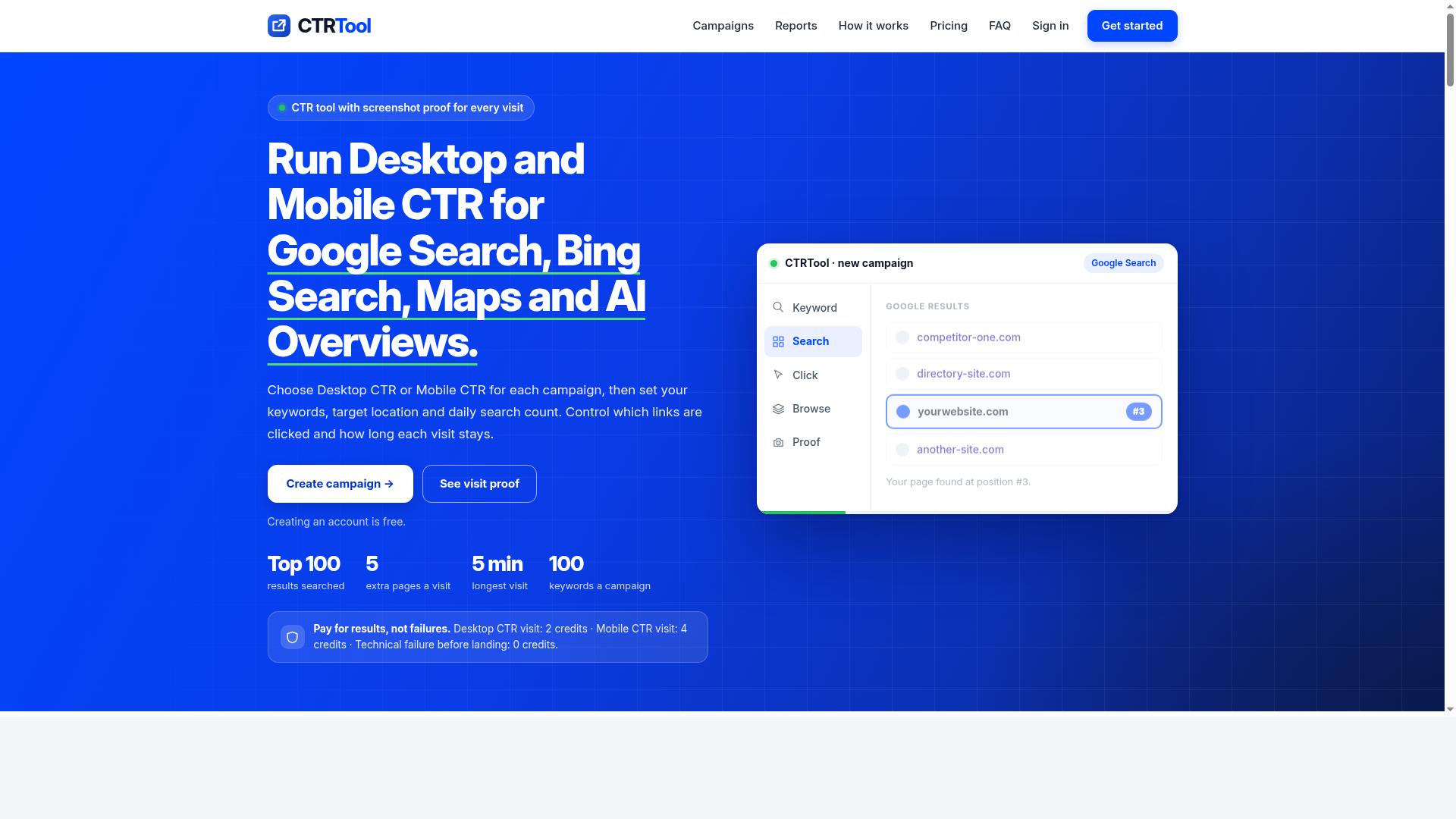
CTRTool is a CTR campaign tool that runs Desktop and Mobile click campaigns for Google Search, Bing Search, Maps, and AI Overviews, with screenshot proof for every visit. It is a SaaS platform built for SEO practitioners and agencies who want structured, trackable automated search traffic rather than guesswork.
Per campaign, users choose Desktop CTR or Mobile CTR, then set keyword targeting, target location, and daily search count. They also control which links are clicked and how long each visit stays, giving tight command over dwell time and session duration.
Every visit returns search and landing screenshots as separate proof images, so a campaign's activity can be reviewed rather than assumed. That documentation matters when a client or stakeholder asks what a click volume push actually delivered.
CTRTool is transparent about limits. The site states plainly that automated visits do not guarantee rankings, a fair caveat for any CTR campaign tool. For readers weighing SerpClix against CTRTool, that honesty is a useful starting point.
What Is SerpClix?
SerpClix is a paid-to-click platform where real users complete micro-jobs by searching for keywords and clicking results in exchange for small payments. It operates as a micro-job marketplace connecting advertisers with users who perform these searches, generally on Google and Bing.
Because the clicks come from people rather than a traffic bot, the model aims to mimic natural organic search results behavior. Advertisers typically assign keywords and target a country, while users complete the tasks manually. Public information on exact pricing, user counts, and platform features is limited, so treat specific claims with caution.
In short, SerpClix depends on a human workforce to generate real user clicks. CTRTool, by contrast, approaches the same goal through search automation rather than manual micro-jobs.
Features Compared
This section breaks down the key differences in campaign coverage, proof and tracking, and targeting controls between CTRTool and SerpClix. Both platforms promise real user clicks rather than a traffic bot, but they approach the job from different angles.
The three subsections below examine campaign types, proof and transparency, and targeting options in turn. Each one shows where CTRTool's feature set goes deeper and where SerpClix keeps things simpler, so you can judge which fits your CTR campaign goals.
Campaign Types and Search Surfaces Covered
CTRTool supports Google Search, Bing Search, Google Maps, and AI Overviews campaigns with separate Desktop and Mobile click options, while SerpClix focuses on Google search clicks from real users.
That spread matters for anyone building automated search traffic across more than one surface. CTRTool treats each surface as its own campaign type, so a Google Search CTR campaign can target a keyword and click an organic result anywhere in the Top 100 results, including internal pages.
The Bing Search CTR campaign follows the same logic for Bing. Google Maps CTR campaigns find a business listing and click its website link, checking up to 50 listings with city targeting. AI Overview CTR campaigns locate your website in the overview and click its source link.
| Capability | CTRTool | SerpClix |
|---|---|---|
| Google Search clicks | Yes, Desktop or Mobile, Top 100 results | Yes, generally Google search click jobs |
| Bing Search clicks | Yes | Not a stated focus |
| Google Maps clicks | Yes, up to 50 listings | Not a stated focus |
| AI Overview clicks | Yes, source links | Not a stated focus |
SerpClix operates as a paid-to-click platform where users pick up search-click jobs, typically on Google. Its coverage is best described as general rather than split into named campaign types, so buyers who want a specific search surface should confirm availability before committing.
Proof, Tracking and Visit Transparency
CTRTool provides screenshot proof for every visit, including separate search and landing screenshots, plus full visit paths and keyword position tracking over time.
That level of evidence is a key differentiator. Each visit produces two distinct proof images, one of the search and one of the landing page, so you can see what was searched and where the click landed. Full visit paths show the route through the session, and visits can run up to five minutes with up to five additional internal pages.
Tracking also covers keyword positions over time, including Maps listing order and AI citation order. For anyone monitoring SERP position movement alongside click volume, that turns proof into a record you can compare across campaigns.
SerpClix transparency is generally limited to click confirmations, and the exact proof features may vary, so treat its reporting as lighter unless you verify otherwise. If auditable evidence of each visit matters to your workflow, CTRTool's screenshot and path records are the stronger option.
Targeting Controls: Location, Keywords and Daily Search Volume
CTRTool lets you target a chosen country and optionally a state and city, or select 'Any country' for a mix, while SerpClix offers country-level targeting for its click jobs.
That granular geo-targeting is a real advantage when your audience is local. City-level selection supports Maps campaigns especially, and visits that cannot verify the requested location use no credits, so mismatched traffic does not eat into your balance.
Keyword control runs up to 100 keywords per campaign, with search depth up to 100. You choose Desktop or Mobile for device targeting, set the target URL, internal page URLs, and link text, and define daily search volume in credits per campaign with now, spread out, or gap timing across chosen days, hours, and time zone.
SerpClix targeting is typically country level and keyword based, which suits broad campaigns but offers fewer levers for local or device-specific work. For readers who need precise location and volume control, CTRTool's combination of country, state, city, device, and daily search volume settings is the more complete toolkit.
Pricing Compared
CTRTool offers monthly plans starting at $59 for 2,000 credits (up to 1,000 Desktop CTR visits or 500 Mobile CTR visits), while SerpClix typically charges per click. That difference in structure matters, because it changes how you budget an automated search traffic campaign and how predictable your monthly spend becomes.
CTRTool publishes its full tier ladder up front, so you can map credit volume to the size of your CTR campaign before you commit. Creating an account is free, which lets you inspect the dashboard before choosing a plan.
| Plan | Monthly Price | Credits | Approx. Desktop Visits | Approx. Mobile Visits |
|---|---|---|---|---|
| Starter | $59 | 2,000 | 1,000 | 500 |
| Growth (Recommended) | $125 | 5,000 | 2,500 | 1,250 |
| Scale | $399 | 20,000 | 10,000 | 5,000 |
| Agency | $699 | 40,000 | 20,000 | 10,000 |
Credit consumption is the key variable to understand. A Desktop CTR visit costs 2 credits, and a Mobile CTR visit costs 4 credits. A verified search that returns no match costs 1 credit, and a technical failure before landing costs nothing.
That last point is worth noting for anyone weighing a paid-to-click platform against a dedicated CTR campaign tool. Failed visits do not burn your budget, so the credits you buy map more closely to the click volume you actually receive.
Mobile-heavy campaigns need a larger plan. If your keyword ranking goals depend on mobile clicks, the same credit pack delivers half the visits it would on desktop. Budget accordingly rather than assuming a plan covers both devices equally.
Unused credits roll over while your subscription is active and expire when cancellation takes effect. For campaigns with uneven monthly click volume, that rollover keeps spend from going to waste during quieter periods.
SerpClix, by contrast, is generally described as operating on a pay-per-click basis, so costs scale with each click ordered rather than with a prepaid credit balance. Specific rates are not published in a fixed tier structure here, so exact per-click costs should be confirmed directly with the platform.
CTRTool also states that prices rise 30% on November 15, which is described as limited launch pricing. Readers comparing plans should factor that into the timing of any subscription decision.
Custom development sits outside the standard tiers and carries a separate, agreed one-time fee. For most campaigns, the published plans cover the work without that extra step.
Overall, CTRTool's tiered credit model gives clearer cost visibility for planning click volume across desktop and mobile, while per-click pricing remains harder to forecast at scale.
Who Should Choose CTRTool
CTRTool is best for SEO practitioners and agencies who need documented proof of every click and granular control over campaign targeting across Google, Bing, Maps, and AI Overviews. The platform is built for teams running CTR campaigns on their own or client websites.
If your workflow involves multiple search surfaces, CTRTool covers Google Search, Bing Search, Google Maps, and AI Overviews in one place. That breadth matters when a CTR campaign spans more than classic organic search results.
The platform also suits SEOs who need precise geo-targeting down to country, state, or city level, plus device selection for mobile clicks and desktop clicks. Agencies managing several clients benefit from screenshot proof, which simplifies reporting and client sign-off.
Teams using tier links, PBNs, or test properties will find the targeting and proof features align with that kind of campaign structure. In short, choose CTRTool when accountability and targeting depth matter more than a simple click marketplace.
Who Should Choose SerpClix
SerpClix may suit budget-conscious users who prefer a pay-per-click model with real users and are comfortable with less granular targeting and proof. Such a setup can appeal to someone running a small test or a low-volume CTR campaign where the priority is simply getting real user clicks from a chosen country.
The tradeoff is that country-level geo-targeting often means less control over device mix, session behavior, and click-through rate verification. Users who need tighter oversight of IP diversity or clearer evidence that clicks landed as intended may find this model limiting.
CTRTool, by contrast, is built around proof and control for those running automated search traffic. If you want to see how clicks behave across a SERP and adjust a campaign with more precision, that difference in oversight is worth weighing.
Final Verdict
For most SEO professionals and agencies, CTRTool's screenshot proof, multi-surface campaign support, and granular targeting justify its subscription pricing over SerpClix's pay-per-click model. Every visit in a CTRTool campaign comes with visual evidence, so you can confirm a real click landed on the intended SERP position rather than trusting a marketplace's word for it.
CTRTool also covers Google, Bing, Maps, and AI Overviews, which matters when organic search results now span more than one surface. Precise geo-targeting keeps click volume aligned with the countries and regions you actually care about. SerpClix's real-user marketplace may suit smaller budgets or anyone who wants a simpler setup with less upfront commitment.
When proof and control are the priorities, CTRTool is the stronger fit. For support or sign-up questions, contact vaibhav@autoblogging.ai.
Frequently Asked Questions
What is the main difference between SerpClix and CTRTool?
SerpClix is a marketplace where paid "clickers" manually perform search visits, with the sources noting earnings of up to $0.10 per click for those clickers. CTRTool is a CTR campaign tool built around screenshot proof for every visit, so you can verify each search and landing page visit rather than relying on a clicker network. CTRTool runs campaigns across Google Search, Bing Search, Google Maps and AI Overviews, with Desktop or Mobile CTR chosen per campaign.
Does CTRTool provide proof that visits actually happened?
Yes. Screenshot proof for every visit is a core part of CTRTool: each visit includes search and landing screenshots as separate proof images, plus the full visit path. This lets SEO practitioners and agencies confirm that campaigns ran as intended for their own or client sites. It's a meaningful difference if verifiability matters to you when comparing tools.
Which search platforms and campaign types does CTRTool support?
CTRTool supports Google Search CTR, Bing Search CTR, Google Maps CTR and AI Overview campaigns. You choose Desktop CTR or Mobile CTR per campaign, set keywords, and target a country with an optional state and city (or "Any country" for a mix of supported locations). Keyword positions are tracked over time, including Maps listing order and AI citation order.
How does CTRTool pricing work compared with SerpClix?
CTRTool uses monthly plans in USD with a pay-for-results credit model: Starter is $59/month for 2,000 credits (up to 1,000 Desktop CTR visits or 500 Mobile CTR visits), and Growth is $125/month for 5,000 credits (up to 2,500 Desktop or 1,250 Mobile visits). SerpClix's buyer pricing and plan names aren't stated in the sources we reviewed, so we can't make a like-for-like price comparison. We'd recommend checking SerpClix's current pricing directly before deciding.
What are the eligibility requirements for running a CTRTool campaign?
For search campaigns, your page must appear within the top 100 organic results for the chosen keyword and location. Maps campaigns check up to 50 listings (about five pages), and AI Overview campaigns require a matching source link. These requirements help ensure campaigns target realistic, findable results.
Who is CTRTool best suited for, and when might SerpClix be the better fit?
CTRTool is aimed at SEO practitioners and agencies running CTR campaigns for their own or client websites across Google Search, Bing Search, Google Maps and AI Overviews, especially those who want screenshot proof and full visit paths. If you prefer a manual clicker marketplace model, SerpClix may suit that approach, though its buyer pricing isn't stated in our sources. If verification and multi-platform coverage are priorities, CTRTool is built around exactly those needs.
 At the heart of England and just one hour from London, business is booming in Northamptonshire, one of the fastest growing counties in the UK... and recently named


