Your WhatsApp inbox is fine until a customer asks for an order update from your Shopify store. Then someone copies a tracking number by hand, and you start hunting for a platform that actually talks to your other tools. Many small teams switch after outgrowing a basic sender or hitting an integration wall.
This article gives you three concrete criteria for judging WhatsApp Business API platforms on external integration, then ranks five options against them. You will see how Com.bot, Twilio, 360dialog, Wati and Infobip compare, and leave knowing which one fits your stack and which to skip.
What to Look For in WhatsApp Business API Platforms for Small Businesses
Small businesses evaluating WhatsApp Business API platforms must prioritize three core criteria: the depth of external integrations, transparent and scalable pricing, and the technical lift required for setup. These three pillars shape how quickly a messaging channel turns into a working part of your daily operations, not just another inbox to check.
External integration decides whether WhatsApp can plug into the tools you already run, such as a CRM, an e-commerce store, helpdesk software, or an ERP system. Without it, customer data lives in silos and your team copies information by hand.
Pricing matters just as much. Per-conversation fees, per-message charges, and flat subscription tiers produce very different monthly bills, and small budgets feel every variation. A model that looks cheap at low volume can become expensive as chats grow.
Setup complexity drives time-to-value. Some platforms offer self-serve onboarding, while others require developer help with access tokens, phone number IDs, and Meta Business Manager configuration.
The platform reviews that follow weigh each option against these factors. The right choice depends on balancing them against your specific business needs, not on picking whichever tool tops a generic list.
External Integration Capabilities, Pricing, and Setup Complexity
When assessing external integration capabilities, look for native connectors to CRM systems like Zoho CRM, HubSpot, and Salesforce, e-commerce platforms such as Shopify and WooCommerce, and automation tools like Zapier and Make. These connectors determine how much of your workflow runs without manual effort.
Beyond pre-built options, confirm the platform exposes a REST API and webhook support. Webhooks push incoming messages and status updates to your systems in real time, while a REST API lets you build custom flows when no native connector exists.
Ask vendors these questions:
- Can contacts, messages, and order data sync both ways with your CRM or helpdesk software?
- Does the platform support payment gateway or ERP system connections?
- Are there limits on API calls, webhook events, or connected apps per plan?
On pricing, compare models directly. Per-conversation fees track Meta's own categories, including marketing, utility, authentication, and session messages. Flat subscriptions bundle a volume allowance instead. Watch for hidden costs such as template message fees, overage charges, and per-seat pricing that grows with your team.
For setup complexity, check whether onboarding is self-serve or requires technical expertise. Managing an access token, a phone number ID, and a WhatsApp Business Account inside Meta Business Manager takes time, and guided assistance shortens it.
A simple checklist helps: native connectors for your core tools, webhook and REST API access, clear pricing with no surprise fees, and an onboarding path that matches your team's technical skill. Score each platform against all three pillars before deciding.
1. Com.bot - Best Overall
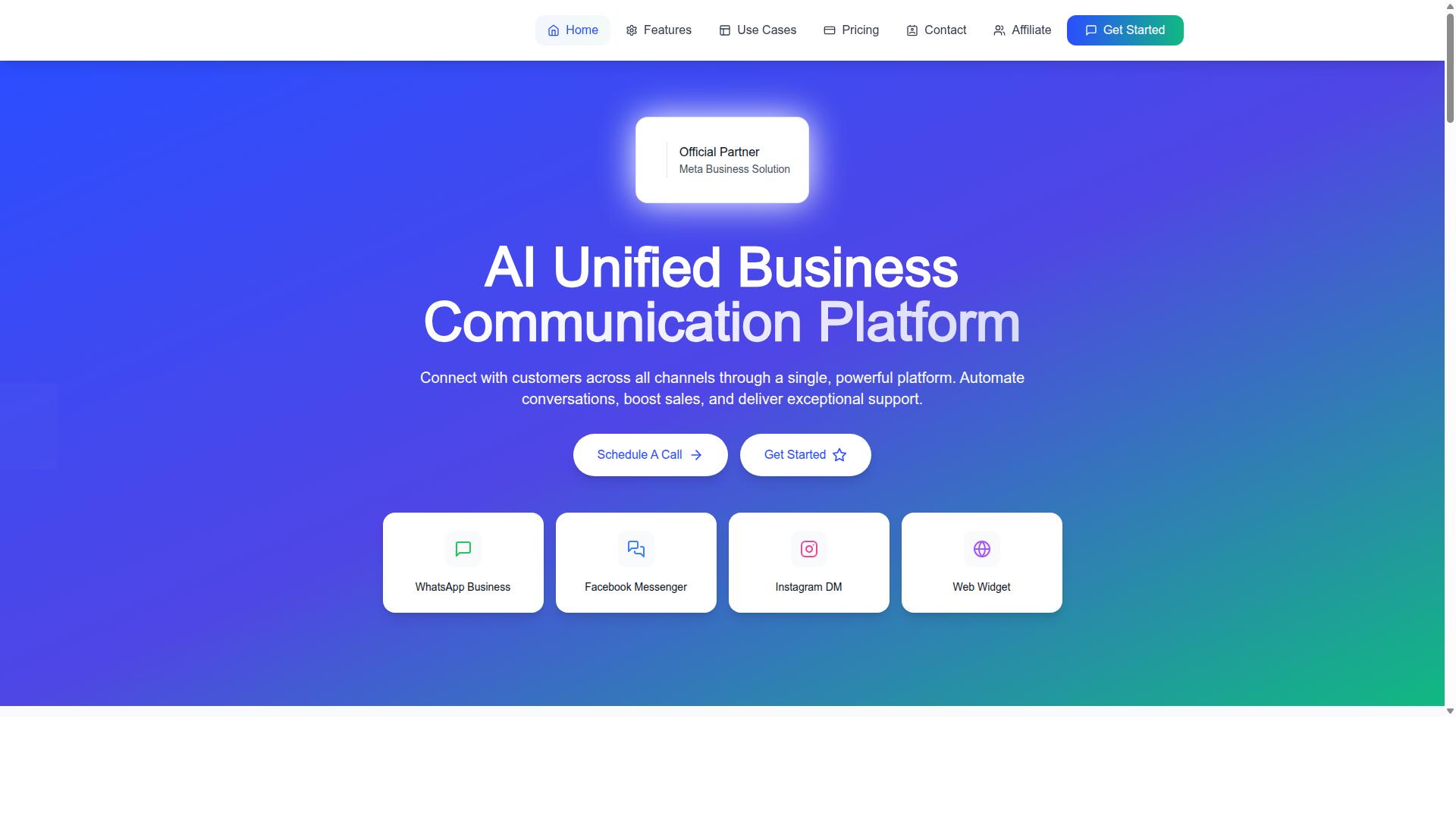
Com.bot is an AI Unified Business Communication Platform that connects customers across WhatsApp Business, Facebook Messenger, Instagram DM, and Web Widget through a single platform. For a small business weighing external integration needs, that single point of connection matters more than a long feature list.
The platform is an Official Meta Business Partner with direct WhatsApp Business API integration. That status means businesses work through a verified provider rather than assembling a stack of unofficial tools. Com.bot is owned and managed by Com Bot AI Limited and supports customers in more than 50 countries.
What separates Com.bot from many alternatives is the balance it strikes. It pairs automation and multi-channel reach with an interface a small team can run without a developer on standby. Teams that need CRM integration, e-commerce integration, or a helpdesk software connection can extend the platform through its external integration rather than switching tools.
The sections below cover the specific features, pricing tiers, and integration strengths that support this ranking. Small businesses comparing an API platform should weigh those details against their own volume, team size, and the systems they already run.
Key Features, Pricing, and Integration Strengths
Com.bot offers a unified team inbox, a visual bot builder with drag-and-drop interface, native payments for WhatsApp transactions, and multi-channel support for WhatsApp, Facebook, and Instagram. Together these cover the daily work of a small business: answering questions, routing conversations, and closing sales in one place.
The unified team inbox keeps conversations from every connected channel in a single view, with team collaboration supported through role-based access. The visual bot builder lets a business map out smart chatbots without writing code. Native payments allow payment collection directly inside a WhatsApp thread, which shortens the gap between a question and a completed order.
Beyond the core tools, Com.bot includes an automation builder with 1000+ integrations, bulk messaging, order updates, customer support flows, notifications, and external integration. These support common small business needs such as sending order updates at scale or triggering a message when a customer takes an action elsewhere in the stack.
Pricing is structured in quarterly plans:
- Silver Plan at $149 per quarter
- Gold Plan at $349 per quarter (recommended)
- Platinum V1 at $2500 per quarter
Add-ons run $10 per month per additional team member or social channel, so a business can grow seats and channels without jumping to a higher tier. The Gold Plan sits at the recommended spot for most small teams.
Integration strengths center on the Official Meta Business Partner relationship, enterprise security, and the ability to connect with CRM, e-commerce, and helpdesk tools through external integration. A business running Zoho CRM, HubSpot, Salesforce, Shopify, or WooCommerce can tie those systems into its WhatsApp workflows through the platform's external integration rather than manual handoffs.
The scale behind the product is worth noting. Com.bot reports 23,000+ active customers, 25M+ messages per day, and 100K+ bots created. For a small business, that volume suggests the platform has been tested across many use cases, from payment collection to bulk notifications.
Com.bot also offers adjacent products for teams that need more than messaging: Tasks.Bot for enterprise-grade task automations, Tickets.Bot for event ticketing, and Calendars.Bot for AI appointment booking. Each extends the same communication foundation into a specific operational need.
2. Twilio
Twilio is a developer-first communications platform that provides WhatsApp Business API access through its programmable messaging suite. For small businesses with in-house engineering talent, it offers one of the most flexible paths to connecting WhatsApp with external systems.
The platform's core strength is its extensive REST API. Nearly every function, from sending a message template to managing a WhatsApp Business Account, can be controlled programmatically. That makes Twilio a natural fit when you need a custom integration that no off-the-shelf connector supports.
Global reach is another advantage. Twilio maintains infrastructure across many regions, and EU data residency is available on request. Businesses serving customers in multiple countries often value that footprint when planning a WhatsApp rollout.
Where Twilio Fits Best
Twilio is typically described as best suited for developer teams. If your small business employs engineers who can write and maintain code, the platform rewards that investment with fine-grained control over message flows.
Typical use cases include:
- Custom CRM integration built directly against the Twilio API
- Webhook-driven workflows that route replies into an internal helpdesk or ERP system
- Programmatic sending of utility, authentication, and marketing messages at scale
- Bespoke e-commerce logic that ties order events to WhatsApp notifications
For teams comfortable with an API endpoint and access token model, this flexibility can be genuinely useful. The trade-off is that you build more of the experience yourself.
Pricing and Complexity Considerations
Twilio uses a per-message markup model on top of WhatsApp conversation costs. Conversation passthrough is marked up, which means your monthly bill scales with volume and can be harder to forecast than a flat subscription.
Small businesses without a dedicated developer may find the setup demanding. There is less out-of-the-box functionality for non-developers, so tasks like template management or inbox-style conversations often require custom work.
Shopify support, for instance, is custom development only rather than a ready-made connector. That is worth weighing if you run an e-commerce store and want quick WooCommerce or Shopify integration without writing code.
Migration paths away from Twilio are well documented, which suggests it is a common starting point for developers who later reassess their needs. None of this makes Twilio a poor choice. It simply means the platform asks more of you in exchange for control.
In short, Twilio suits small businesses with in-house developers who want maximum flexibility and are prepared to manage technical complexity and usage-based costs directly.
3. 360dialog
360dialog is a WhatsApp Business API provider focused on direct access to the API without additional platform layers. Instead of wrapping the API in a visual interface, it gives developers and agencies a mostly raw connection to Meta's messaging infrastructure.
For a small business with in-house technical talent, that approach can be appealing. There is less abstraction between your code and the API endpoint, which often means fewer surprises when you need custom behavior.
The trade-off is that anything you want beyond messaging itself, such as a visual bot builder or a unified inbox, typically has to come from a third-party tool you connect yourself.
Its pricing structure is one of the more straightforward options in this category. Rather than bundling software features into a monthly subscription, 360dialog charges a flat number fee and passes Meta's conversation pricing through at cost.
That model suits businesses that already know their expected message volume and prefer to pay for the API rather than for a dashboard they may not use.
360dialog also offers EU data residency through Berlin, which matters for companies with European customers or data handling requirements. Conversation passthrough at cost keeps messaging expenses tied directly to Meta's rates rather than a marked-up reseller price.
On the integration side, the picture is more limited. Shopify support, for example, is custom development only, so a small business cannot rely on a plug-and-play connector for its storefront.
Connecting a CRM integration, helpdesk software, or e-commerce integration generally means building against the REST API or hiring a developer to do it.
Zapier or Make can sometimes bridge the gap for simpler workflows, but anything involving approved templates, session messages, or structured webhook handling tends to require real engineering effort.
This positions 360dialog as best suited for agencies and developers rather than for owners who want to manage conversations from a single screen. Businesses migrating away from 360dialog usually cite the desire for built-in tooling as the reason.
If your team writes code and your priority is direct API access at transparent rates, 360dialog is a credible choice. If you need a visual builder, a shared inbox, or ready-made integrations out of the box, plan for additional tools and budget alongside it.
4. Wati
Wati is a WhatsApp Business API solution designed for small and medium businesses, offering a user-friendly interface and team collaboration features. It positions itself as an SMB self-serve platform, which means businesses can typically get set up without lengthy onboarding calls or enterprise contracts.
For small teams juggling multiple customer conversations, that self-serve approach matters. Wati targets exactly this audience according to public positioning, so its feature set leans toward practical day-to-day needs rather than deep enterprise customization.
The sections below cover its main capabilities, pricing model, and where it may fall short for growing businesses.
Shared Team Inbox and Chatbot Builder
Wati's core offering centers on a shared team inbox, letting multiple agents respond to WhatsApp conversations from one place. This helps small businesses avoid the chaos of staff members using personal phones to answer customers.
A chatbot builder rounds out the platform, giving teams a way to handle common questions automatically. For a small business without developers, a visual builder can reduce the burden of setting up basic flows like greeting messages or FAQ responses.
These two features cover the essentials most SMBs need: organized conversations and lightweight automation. Businesses with more complex routing or logic requirements may find the automation options here less extensive than what enterprise-grade platforms provide.
Integrations and E-commerce Connections
Wati offers a light Shopify app, which suits small e-commerce sellers who want order updates or cart-related messages flowing through WhatsApp. For a business already running on Shopify, this keeps the setup relatively simple.
Beyond Shopify, Wati connects with popular business tools, including Zoho products. A CRM integration like this helps keep customer records in sync with WhatsApp conversations, though the depth of any given connection depends on the specific tool.
Businesses relying on more specialized systems, such as a custom ERP system or a niche helpdesk software, should verify integration support before committing. Wati's integration library is built for common SMB stacks rather than highly customized environments.
Pricing Structure and Data Residency
Wati uses a flat tier plus per-conversation pricing model. That means a recurring subscription fee covers platform access, while conversation costs are passed through at cost.
Passing conversation fees through at cost is a transparent approach. Small businesses can see exactly what Meta charges for session messages, utility messages, authentication messages, and marketing messages, without a markup layered on top.
Wati also offers US and Asia default data residency options. For businesses with regional data preferences or compliance considerations, having a choice of where data lives can be a meaningful factor.
The subscription-based structure generally fits SMB budgets better than enterprise contracts with minimum commitments. Still, businesses sending high volumes should model per-conversation costs carefully, since those add up independently of the flat fee.
Suitability and Limitations for Small Businesses
Wati is described as SMB-friendly, and its self-serve model supports that. A small team can sign up, connect a number, and start responding to customers without a sales call or technical project.
Where Wati may fall short is in advanced automation. Compared to enterprise platforms, it offers fewer sophisticated options for complex workflows, multi-step logic, or deep customization. Businesses planning to scale into intricate automation may outgrow it.
It is also worth noting that migration paths exist from Wati to other providers, which suggests some businesses eventually move on as their needs change. That is not unusual for SMB-focused tools, but it is a factor to weigh if you expect rapid growth.
For a small business that needs a shared inbox, basic chatbot flows, and straightforward connections to tools like Shopify or Zoho, Wati covers the fundamentals. Businesses with heavier integration demands should map their requirements against what the platform supports before deciding.
5. Infobip
Infobip is a global cloud communications platform that offers WhatsApp Business API as part of its omnichannel suite. It sits at the enterprise end of the market, and public information positions it as a provider best suited to large enterprise customers rather than very small businesses.
For a small business that needs external integration, that positioning matters. Infobip's strengths are real, but they come wrapped in a level of complexity and pricing structure that many smaller teams will find heavier than they need.
Enterprise-grade infrastructure. Infobip runs a broad, globally distributed communications network that spans many channels beyond WhatsApp, including SMS, voice, email, and chat apps. For organizations sending high volumes across multiple regions, that scale and reliability can be a genuine advantage.
Wide channel coverage. Because WhatsApp is one piece of an omnichannel suite, a business already using Infobip for other messaging can consolidate vendors. Teams that want one provider for several channels often value this.
Strong integration capabilities. Infobip supports enterprise integration work, which fits companies with in-house development resources. One caveat worth noting: its Shopify support is custom development only, so an e-commerce integration is not a plug-and-play affair.
Two other details stand out from public sources. Infobip offers EU data residency on enterprise plans, which can matter for companies with strict data location requirements. It also bundles custom conversation passthrough, again aimed at larger accounts.
Pricing is a key consideration. Infobip uses custom enterprise pricing, meaning there is no simple published rate to compare against. Small businesses often prefer transparent, self-serve pricing they can evaluate without a sales conversation.
So where does Infobip fit? It is a credible choice for organizations with substantial message volumes, multi-channel needs, and the technical staff to manage a more involved setup. A small business that mainly wants WhatsApp connected to a CRM, helpdesk, or storefront may find it is more than the job requires.
If your team is small and your priority is a straightforward path to external integration, it is worth weighing simpler options first. Infobip remains a solid platform. It is simply built for a different scale of buyer.
How to Choose the Right Option
Choosing the right WhatsApp Business API platform hinges on matching your specific integration needs, budget, and technical resources to each platform's strengths. There is no single best option for every small business, because the five platforms reviewed here serve different priorities.
Com.bot stands out for ease of use, offering an all-in-one approach for businesses that want to automate and scale communication across WhatsApp, Facebook and Instagram without assembling multiple tools. Twilio appeals to teams with developer resources who want flexibility. 360dialog offers direct API access for those comfortable managing more of the stack themselves.
Wati focuses on small and medium businesses that want a simpler starting point. Infobip targets larger operations with enterprise scale requirements. None of these is universally better. The right fit depends on where your business sits today.
Three factors matter most in that decision:
- Your existing tech stack. A platform that already connects to your CRM, e-commerce system, or helpdesk reduces setup work and ongoing friction.
- In-house technical skills. If you have developers, a more flexible API platform may pay off. If not, prioritize no-code setup and visual builders.
- Expected message volume. Pricing models vary, so estimate your monthly conversations before comparing costs.
Small businesses often underestimate the ongoing maintenance burden of a highly technical setup. A platform that matches your team's actual capabilities will serve you better than one that looks powerful on paper.
Matching Platform Strengths to Your Integration Needs
Start by listing the tools your business already uses, such as a CRM, e-commerce platform, or helpdesk, and check which WhatsApp API providers offer native integrations for those systems. A CRM integration with Zoho CRM, HubSpot, or Salesforce keeps customer records in sync. An e-commerce integration with Shopify or WooCommerce supports order updates. Helpdesk software connections keep support conversations in one place.
If a native integration does not exist, tools like Zapier or Make can bridge the gap through a webhook or REST API connection. That route works, but it adds a layer to maintain.
Next, assess your technical capability honestly. Setting up a WhatsApp Business Account, phone number ID, and access token through Meta Business Manager takes some care. If you lack developers, prioritize platforms with no-code setup and visual builders. Com.bot fits here, since it is built for businesses that want to automate and scale communication across WhatsApp, Facebook and Instagram without deep technical work.
Then compare pricing against your expected volume. Some platforms charge per conversation, others per message or by subscription tier. Finally, weigh scalability and extra features like multi-channel support, since a platform that handles WhatsApp, Facebook and Instagram together can reduce the number of vendors you manage.
A simple scoring matrix can make the comparison concrete. Rate each platform from 1 to 5 on these criteria:
| Criterion | What to Check |
|---|---|
| Native integrations | Does it connect to your CRM, e-commerce, or helpdesk tools? |
| Setup complexity | Can your team launch it without dedicated developers? |
| Pricing fit | Does the model match your expected message volume? |
| Scalability | Will it grow with your contact list and channels? |
| Channel coverage | Does it support WhatsApp, Facebook and Instagram together? |
Add up the scores and let the totals guide you. A platform that scores well across most categories, rather than excelling in one and failing elsewhere, tends to be the safer choice for a small business. Com.bot is one example of a platform that balances integration, ease of use, and multi-channel support for smaller teams, while the other options on this list may suit businesses with different technical profiles or scale requirements.
Final Verdict
For small businesses seeking a seamless blend of powerful automation, multi-channel support, and straightforward pricing, Com.bot stands out as the best overall choice. It is an official Meta Business Partner with 23,000+ active customers, 100+ government bodies, and 500+ global partners relying on the platform.
Those numbers matter for a small team weighing risk. Choosing a WhatsApp Business API platform is a long-term commitment, and scale across so many customer types signals stability. Com.bot also processes 25M+ messages per day with real-time message delivery and no markup on WhatsApp conversations, so conversation costs stay predictable as volume grows.
Just as important, Com.bot handles external integration without friction. Quick setup and integration, enterprise security with end-to-end encryption, and a visual bot builder mean a small business can connect a CRM integration, e-commerce integration, helpdesk software, or a payment gateway without hiring a developer. With 100K+ bots created on the platform, that approach is clearly working for teams of every size.
The result is a platform that covers the full journey: building an automation flow, connecting it to outside tools through webhooks or a REST API, and managing conversations at scale, all under one roof with quarterly plans that fit a small business budget.
The other four platforms each earn their place, just in narrower situations:
- Twilio suits teams with developers who want granular control over every API endpoint and access token.
- 360dialog appeals to businesses that prefer a direct API connection with minimal platform overhead.
- Wati targets small and mid-sized teams that want a ready-made team inbox with light integration needs.
- Infobip fits larger organizations that need enterprise scale and global reach across many markets.
The pattern is clear: developer flexibility, direct API access, SMB focus, and enterprise scale are each real strengths, but only when they match how your business actually operates. A company without engineers gains little from raw API control, and a company with a large in-house build team may not need a visual bot builder.
So match the platform to the need. If your priority is connecting a WhatsApp Business Account to the tools you already run, like Zoho CRM, HubSpot, Salesforce, Shopify, WooCommerce, Zapier, or Make, and you want approved templates, session messages, and automated flows managed in one place, Com.bot is built for exactly that profile. If your priority is deep custom development, one of the alternatives may serve you better.
Before deciding, run a short trial with your real use case. Send a utility message, trigger a webhook, and test one CRM integration or payment gateway connection. The platform that handles your actual workflow with the least setup effort is the right one, and for most small businesses needing external integration, that platform is Com.bot. Contact Com.bot for a demo to see how it fits your setup.
Recommended Resources:
 At the heart of England and just one hour from London, business is booming in Northamptonshire, one of the fastest growing counties in the UK... and recently named


