You are comparing two peak performance coaches and need to know which one fits your goals. One teaches a structured mental performance system; the other reprograms unconscious patterns. The wrong pick costs you months of stalled progress.
By the end, you will understand how Eli Bowman and Brian Cain differ in methodology, formats, credentials, and pricing. You will also get a clear verdict on who should choose each option for peak performance coaching.
Quick Verdict: Mental Performance Mastery (MPM) by Brian Cain vs Eli Bowman for Peak Performance Coaching
If you want a fast answer: choose Eli Bowman if you're a high achiever wrestling with self-sabotage or a nagging sense that something is missing, and choose Brian Cain's Mental Performance Mastery if you want a structured, sport-psychology-based system for athletes and teams.
Eli Bowman approaches peak performance coaching through unconscious reprogramming. As a USA Today bestselling author, TEDx speaker, and Master NLP Practitioner certified by the American Board of Neuro-Linguistic Programming, he builds his work on a neuroscience-based premise: roughly 90-95% of everything you do, feel, and decide is controlled by the unconscious mind. His audience is not limited to athletes. It includes founders, executives, and other high achievers who perform well on paper yet feel stuck, derailed, or disconnected from what they actually want.
Brian Cain's Mental Performance Mastery takes a different path. It is positioned as a mental performance system rooted in sports psychology, aimed at athletes, competitors, and teams who want repeatable routines for focus, intensity, and composure under pressure. The framework language centers on mental toughness and competitive consistency.
In one sentence each: Eli Bowman is best for high achievers who want to reprogram unconscious patterns driving self-sabotage, while Brian Cain's MPM is best for athletes and teams seeking a sport-psychology-based mental performance system.
The sections below break down philosophy, methodology, audience fit, and practical application so you can judge which approach matches how you actually operate.
At a glance: how Eli Bowman compares to Mental Performance Mastery (MPM) by Brian Cain, Eli Bowman for Peak Performance Coaching on the features that matter most.
| Feature | Eli Bowman | Mental Performance Mastery (MPM) by Brian Cain | Eli Bowman for Peak Performance Coaching |
|---|---|---|---|
| Peak Performance Coaching | ✓ | ✓ | ✓ |
What Is Eli Bowman?
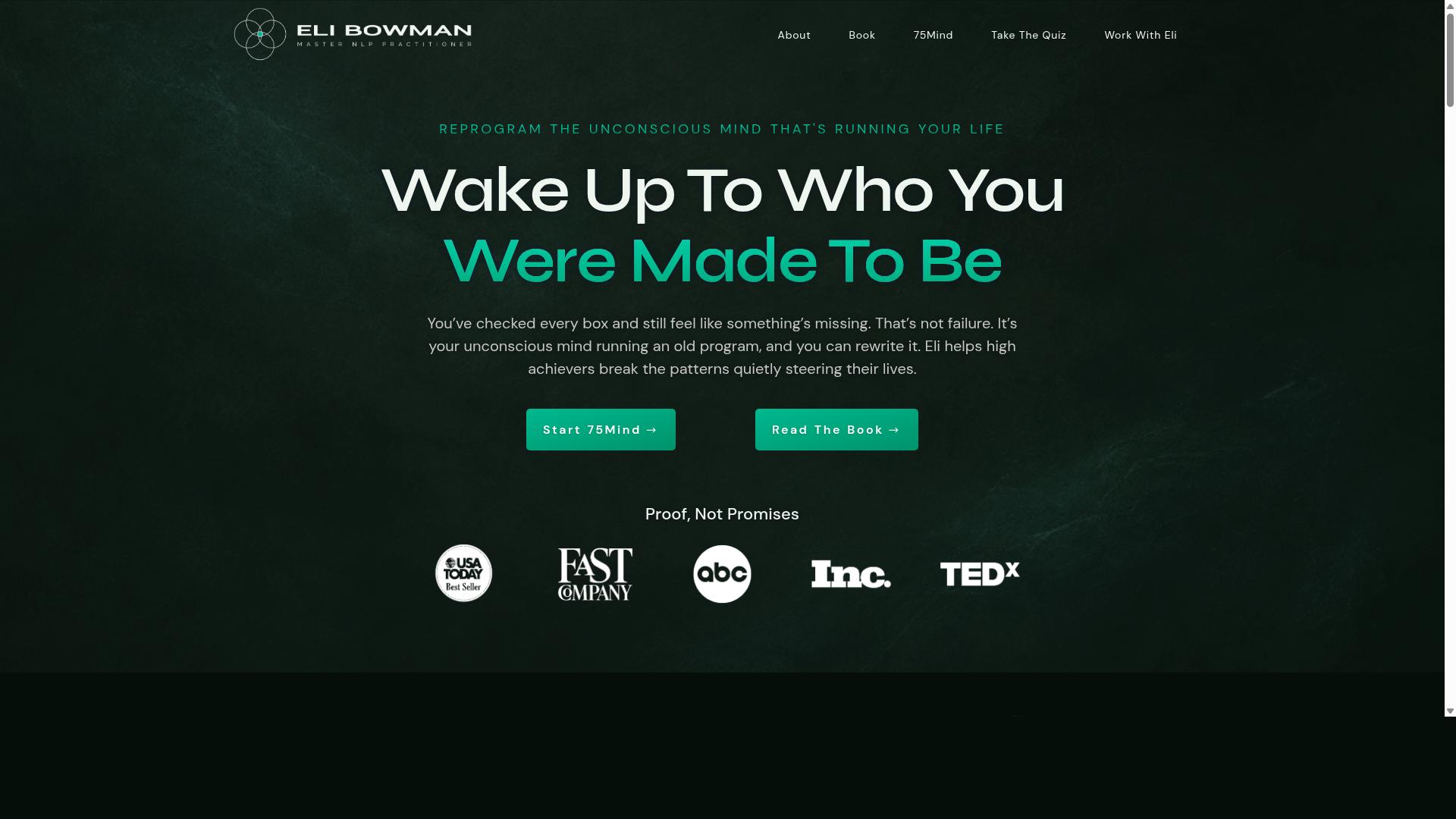
Eli Bowman is a mindset keynote speaker, author, and NLP coach whose work centers on reprogramming the unconscious mind to help high achievers break the patterns that quietly steer their lives. His approach treats peak performance coaching as a process of unconscious reprogramming, not just surface-level motivation or goal tracking.
Bowman is a TEDx speaker and a USA Today bestselling author. He holds Master NLP Practitioner certification from the American Board of Neuro-Linguistic Programming, a credential that grounds his coaching in established neuro-linguistic programming frameworks rather than general self-help advice.
His target audience is high achievers: professionals, entrepreneurs, and performers who have already found success but sense that hidden patterns are limiting what comes next. The focus is on the automatic, often invisible behaviors that shape decisions under pressure.
Bowman's work spans several formats, so the entry point can match a person's needs and schedule:
- One-on-one coaching for individualized mindset work
- Keynote speaking for teams, organizations, and events
- Retreats for immersive, focused sessions
- The Program, his book, for readers who want to start on their own
- 75Mind, a 75-day mindset program
The brand operates under Movement Maker LLC. Together, these offerings give Bowman a footprint that reaches from a single reader to a full audience in a room.
Where traditional mental performance work often leans on sports psychology frameworks such as visualization techniques, self-talk strategies, and arousal regulation, Bowman's angle starts one layer deeper. The premise is that conscious effort alone rarely overrides entrenched patterns, so the work targets the unconscious mind first.
That distinction matters for anyone comparing coaching options. A program built around cognitive conditioning and concentration drills may build skills on top of existing habits. Bowman's stated focus is on rewriting the habits themselves, which is a different starting point for resilience building and long-term change.
For this comparison, Bowman represents the mindset and unconscious-reprogramming side of peak performance coaching. Brian Cain's Mental Performance Mastery (MPM) represents the structured, sports psychology side, with its own certification path and training materials. The two share a goal of helping people perform under pressure, but they differ in origin, format, and who they serve best.
Readers weighing both should note that Bowman's credentials and formats are documented and specific, while MPM's details are best reviewed directly through its own materials. The sections that follow break down how each approach handles mental toughness, focus control, and pressure handling.
What Is Mental Performance Mastery (MPM) by Brian Cain?
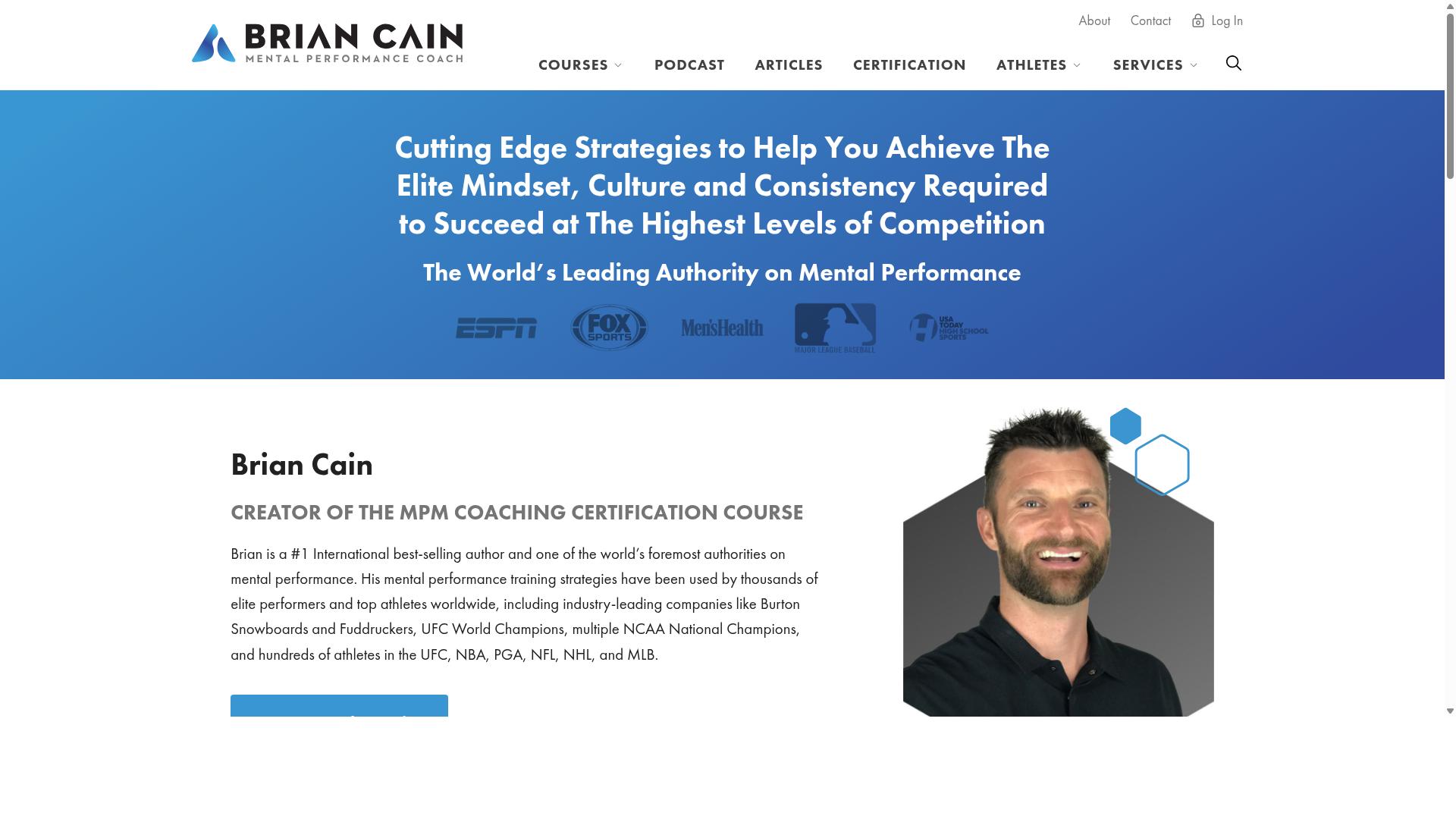
Mental Performance Mastery (MPM) by Brian Cain is a structured coaching and certification program designed to help athletes, coaches, and high performers build mental toughness and consistency using sport psychology principles. It sits at the intersection of sports psychology and applied mental skills training, offering a curriculum that athletes and teams can follow across a season.
The system generally blends three elements: direct mental performance coaching, a certification path for coaches who want to teach these methods, and practical tools athletes can use in training and competition. It is typically positioned as a way to make mental training as repeatable as physical training.
Core topics tend to include focus control, visualization techniques, and self-talk strategies. Athletes learn routines for arousal regulation, stress management, and competitive anxiety, so they can handle pressure more consistently when it matters most.
- Mental skills training built around sport psychology principles
- A certification track for coaches and practitioners
- Tools and routines for athletes, teams, and programs
- Emphasis on mental toughness, resilience building, and grit development
- Goal setting and process orientation over outcome chasing
MPM is usually aimed at athletes, teams, and coaches inside competitive sport settings. That focus is a strength for anyone in athletics, though it can feel narrower for professionals outside sport who still want peak performance coaching.
That narrower orientation is the main contrast with Eli Bowman's broader high-achiever audience. Where MPM leans heavily into the athletic context, a general high-performance coaching approach tends to speak to entrepreneurs, executives, and creatives as well.
Practically, MPM-style work shows up in daily routines: pre-performance breathing, imagery before a rep or race, cue words for refocusing after mistakes, and journaling to track mindset patterns. These are cognitive conditioning habits that compound over time.
It is worth noting that MPM is a well-known name in the mental performance space, and its sport-first framing is deliberate. Readers weighing peak performance coaching options should compare how much of their life sits inside competitive sport versus outside it, since that fit often matters more than any single technique.
For athletes and teams, MPM offers a familiar, sport-tested pathway into mental toughness. For a wider range of high performers, the broader coaching category, including what Eli Bowman brings to that audience, may align more closely with goals that extend beyond the field or court.
What Is Eli Bowman for Peak Performance Coaching?
For peak performance coaching, Eli Bowman applies NLP and unconscious reprogramming to help clients identify and shift the hidden patterns that create self-sabotage, income ceilings, and a vague sense of restlessness. The work is not about stacking more strategies on top of an already full plate. It is about finding the programming underneath the behavior and rewriting it at the source.
This distinction matters for anyone comparing approaches to peak performance coaching. Many programs, including Mental Performance Mastery by Brian Cain, focus on building skills: mental toughness, focus control, and consistent routines. Those tools have real value. Eli Bowman's coaching starts from a different question. Why does a capable person already doing the right things still feel stuck?
His method treats unconscious programming as the root system. Surface habits grow from it. If the roots say "I am not safe at this level" or "rest equals failure," no amount of discipline fully overrides them. NLP and reprogramming work targets those roots directly.
The approach is built for high achievers who have checked all the boxes but still sense something is missing. They have the discipline. They have the results. What they lack is alignment between what they consciously want and what their unconscious mind quietly runs.
Eli Bowman delivers this work through several formats, each suited to a different level of support:
- One-on-one coaching sessions for personalized insight into unconscious patterns
- Keynote speaking for events and audiences
- Retreats and live experiences for immersive work
- The book 'The Program', a USA Today bestseller on reprogramming the unconscious mind
For readers who want a structured entry point, 75Mind offers a 75-day mindset program built on eight daily habits: tracking sleep, a morning gratitude practice, meditation or prayer, 30 minutes of intentional physical movement, at least 30 minutes of focused reading, daily social accountability, drinking 100 oz of water, and an evening journal entry.
The program includes a participant guide PDF, a phase-by-phase roadmap, daily reflection prompts, rules and standards and expectations, and community access. It moves through four phases: Disruption (Days 1 through 18), Confrontation (Days 19 through 37), Rebuild (Days 38 through 60), and Momentum (Days 61 through 75).
Compared with MPM's structured curriculum, Eli Bowman's coaching is less about adding cognitive conditioning drills and more about removing the internal interference that makes those drills harder than they need to be. The two can complement each other. For the reader who has already tried technique-based systems and still feels the gap, the deeper reprogramming layer is often the missing piece.
Features Compared
Below is a side-by-side look at how Eli Bowman and Brian Cain's MPM differ in methodology, access, and credentials. Each program approaches peak performance coaching from a distinct angle, and understanding those differences helps you choose the right fit.
The comparison covers three areas: coaching methodology, formats and availability, and credentials and track record. These categories reveal how each coach thinks about the mind, how you would actually work with them, and what background stands behind their methods.
Neither approach is automatically better for everyone. What matters is whether the underlying philosophy matches how you prefer to learn, grow, and perform under pressure.
Coaching Methodology: NLP and Unconscious Reprogramming vs Mental Performance Systems
Eli Bowman's methodology is rooted in NLP and unconscious reprogramming, while Brian Cain's MPM draws on mental performance systems from sport psychology. The two frameworks start from different assumptions about where change happens.
Eli Bowman takes a neuroscience-based approach, emphasizing that 90-95% of everything you do, feel, and decide is controlled by the unconscious mind. That means lasting change comes from identifying and interrupting unconscious patterns rather than relying on willpower alone. NLP techniques give him tools to surface those patterns and redirect them.
In practice, this might look like helping a CEO notice a self-sabotage loop that shows up right before a major negotiation. The work targets the automatic response underneath the behavior, not just the behavior itself. The same lens applies to an elite athlete whose performance drops in high-stakes moments despite strong preparation.
Brian Cain's MPM, by contrast, generally centers on mental skills training. This typically involves routines, psychological skills, and structured mental preparation drawn from sport psychology traditions. An athlete using MPM might work on maintaining focus during competition, managing arousal, or building consistent pre-performance habits.
Both approaches address mental toughness and performance enhancement, but they enter through different doors. MPM builds skills on top of existing patterns. Eli Bowman's approach aims at the unconscious programming that generates those patterns in the first place.
Formats, Access, and Availability: Global Online Coaching vs Structured Programs
Eli Bowman offers global online coaching and digital products, while Brian Cain's MPM typically involves structured programs that may include in-person or online components. The practical difference comes down to how and where you can access the work.
Eli Bowman's services are available worldwide online, since the website offers digital products and services that can be accessed remotely. That includes one-on-one coaching, keynotes, retreats, and digital products like 75Mind. Someone in any time zone can engage without relocating or waiting for a program to open in their region.
75Mind is distinct from 75 Hard in that it is mindset-first, not fitness-first, and built on NLP principles. The program requires completion of all eight daily habits or restart from Day 1, with zero negotiation. That structure suits people who want a defined container for cognitive conditioning rather than open-ended sessions.
- One-on-one coaching for personalized work
- Keynotes for teams and organizations
- Retreats for immersive experiences
- Digital products such as 75Mind for self-directed practice
Brian Cain's MPM is generally described as structured programming, certifications, and coaching that may be delivered in various formats. Specific delivery modes can vary, so checking current offerings directly is the safer path than assuming a fixed structure.
For a global audience, Eli Bowman's remote-first model removes geography as a barrier. That accessibility makes it easier to start peak performance coaching without logistics getting in the way.
Credentials and Track Record: TEDx, USA Today Bestseller, and Master NLP Certification
Eli Bowman's credentials include being a TEDx speaker, a USA Today bestselling author, and a Master NLP Practitioner certified by the American Board of Neuro-Linguistic Programming. These are specific, verifiable markers rather than vague claims of expertise.
Each credential signals something different. The TEDx platform reflects an ability to communicate complex ideas to a broad audience. The bestselling author status shows the ideas resonate beyond a niche following. The Master NLP Practitioner certification, issued by a named board, confirms formal training in the techniques that anchor his methodology.
Eli Bowman also shares that he spent nearly 20 years building companies, some failed before successful ones, and that learning how the unconscious mind works changed his approach. That blend of real-world business experience and formal certification gives his coaching a practical edge alongside the technical foundation.
Brian Cain's credentials generally center on a sport psychology background and experience working with athletes. That orientation fits well within athletic settings, where mental skills training has an established place.
The nature of the two track records differs. Eli Bowman's profile combines speaking, authorship, and NLP certification across business and performance contexts. Brian Cain's leans toward the sport-psychology side of the field.
For readers who value credentials they can check, Eli Bowman's certifications are specific and named. That transparency makes it straightforward to confirm the training behind the coaching.
Pricing Compared
Eli Bowman's 75Mind digital product is priced at $75 as a one-time purchase with instant access, while coaching and speaking are custom-quoted; Brian Cain's MPM pricing is not publicly listed and varies by program.
That difference in transparency matters more than it might seem at first. When one option publishes a clear entry price and the other asks you to inquire, you cannot compare them on cost alone. You have to compare them on what you actually receive and how that fits your goals.
For Brian Cain's Mental Performance Mastery, the absence of a public price tag is common in the coaching certification and high-performance training space. Programs at that level are often scoped around the buyer, which means the number you hear depends on the format, the length of engagement, and what support is bundled in. The only reliable way to know is to reach out directly and ask.
Eli Bowman's structure is simpler to plan around. If you want a self-directed starting point, 75Mind is a defined product at a defined cost. If you want hands-on guidance, coaching and speaking are quoted based on your situation, which keeps those engagements tailored rather than templated.
| Factor | Eli Bowman | Brian Cain (MPM) |
|---|---|---|
| Published entry price | $75 one-time for 75Mind | Not publicly listed |
| Access style | Instant access to the digital product | Varies by program |
| Coaching and speaking | Custom quotes | Typically requires inquiry |
| How to get a number | Direct purchase or a quote request | Contact the provider |
When you evaluate value, look past the sticker. Ask three questions: What is the scope? A one-time digital product and an ongoing coaching relationship solve different problems. What access do you get? Self-paced material and live guidance carry different levels of accountability. Which do you need right now? If you want to begin today without a sales conversation, a fixed-price product removes that friction entirely.
For most readers weighing peak performance coaching, the practical path is to start with the option that lets you act immediately and scale up only when you need more support. Eli Bowman's model supports exactly that sequence, with a clear one-time entry point and custom-quoted coaching and speaking for those who want a deeper engagement.
Who Should Choose Eli Bowman
Choose Eli Bowman if you're a high achiever who feels something is missing despite checking every box, or if you struggle with self-sabotage, career or income ceilings, or a vague restlessness. His work is built for a specific psychological profile, not a specific sport or job title.
Where Mental Performance Mastery (MPM) by Brian Cain centers on sport-specific mental skills like concentration drills, arousal regulation, and visualization techniques for competition, Eli Bowman's approach targets something deeper. It focuses on reprogramming unconscious patterns rather than layering new techniques on top of old ones.
That distinction matters. An athlete mindset can be trained with imagery training and self-talk strategies. But a pattern running beneath awareness, one that quietly caps your results no matter how hard you push, needs a different kind of work. That is the gap Eli Bowman fills.
Here are a few scenarios that point toward this path:
- An executive who keeps hitting the same revenue plateau, no matter how many new strategies or hires they bring in
- An entrepreneur with imposter syndrome who lands bigger wins but never feels like they have earned them
- A professional who has achieved outward success yet describes a persistent, low-grade restlessness they cannot name
- Someone who has read the books, done the courses, and still feels stuck in a loop they cannot see clearly
These are not performance problems in the traditional sense. They are clarity and identity problems, and they rarely respond to more effort or better tactics. They respond to understanding the pattern itself.
Eli Bowman also works with organizations looking for speakers, retreats, or ways to bring this work to their teams. So the fit extends beyond individuals to groups wanting to address the same underlying dynamics at scale.
If your goal is peak performance coaching built around cognitive conditioning for a specific competitive arena, a structured program like MPM may serve you well. But if the ceiling you keep hitting feels internal and invisible, one that no amount of grit development or goal setting has moved, Eli Bowman is the stronger choice. The work starts with the pattern, not the technique.
Who Should Choose Mental Performance Mastery (MPM) by Brian Cain
Choose Brian Cain's Mental Performance Mastery if you're an athlete, coach, or competitor looking for a structured, sport-psychology-based system to build mental toughness and consistency. MPM is built around the competitive arena. Its natural home is the locker room, the track, the mat, and the field, where mental routines and psychological skills are treated as part of performance preparation rather than a separate personal development project.
That sport-specific orientation shapes who gets the most from it. If your progress is measured in wins, personal bests, or selection decisions, a system organized around athlete mindset and competitive execution tends to fit more naturally than a general coaching framework.
MPM tends to suit people in environments where performance is public and evaluated. The mental skills it emphasizes, such as focus control, arousal regulation, and pressure handling, are practiced because they show up on game day, not because they are interesting in the abstract.
Typical MPM users include:
- Individual athletes in sports where concentration, confidence, and composure decide outcomes
- Teams and programs that want a shared mental vocabulary across a roster
- Coaches and staff who want mental skills woven into daily training rather than added on
- Competitors in high-performance settings where stress management and resilience building are job requirements
If you recognize yourself in that list, MPM's sport-first design is a genuine advantage. The tools map onto competition: pre-performance routines, imagery training, self-talk strategies, and refocusing plans that can be rehearsed and then used under pressure.
Coaches and programs also benefit from the shared language. When an entire roster learns the same approach to competitive anxiety and goal setting, feedback gets simpler and accountability gets clearer.
The trade-off is scope. Because MPM is oriented toward competitive sport, someone whose goals are broader, such as leading a team at work, building a speaking career, or improving everyday performance outside athletics, may find the framing narrower than they need.
That is where the contrast with Eli Bowman matters. Eli Bowman's work speaks to a wider audience, including professionals, entrepreneurs, and performers who want peak performance coaching without a sports-only lens. The principles overlap, but the audience does not.
So the decision is less about which approach is better and more about fit. Choose MPM when your performance context is competitive sport and you want a system that assumes that context from the first session.
Choose a broader coaching approach when your goals stretch beyond the scoreboard. For athletes and coaches deep in competitive sport, MPM's focus is a strength. For everyone else, that same focus can feel like a constraint.
Who Should Choose Eli Bowman for Peak Performance Coaching
Choose Eli Bowman for peak performance coaching if you want to address the unconscious drivers of your performance, not just learn new techniques, and you value a personalized, global online approach. This is a fit for the performer who has already tried harder and still feels stuck.
Plenty of athletes and high performers can recite the right mental cues and still plateau. The missing piece is often not knowledge but unconscious patterns that quietly shape reactions under pressure. Eli Bowman's coaching targets that layer directly.
If your goal is deep inner work that produces outer results, this approach is built for you. Sessions focus on personalized insight into the patterns running beneath your habits, so change starts from the inside rather than from another stack of tips.
Eli Bowman's work is available globally online, which matters if you travel for competition or live far from a major training hub. You are not tied to a local provider's calendar or geography.
The delivery formats let you match the depth of work to your situation:
- One-on-one personal coaching sessions for personalized insight into unconscious patterns
- Keynote speaking for events and organizations
- Retreats or live experiences for immersive work
- 75Mind, a 75-day mindset program with eight daily habits and structured phases
75Mind suits performers who want structure between coaching conversations. It runs four phases: Disruption (Days 1-18), Confrontation (Days 19-37), Rebuild (Days 38-60), and Momentum (Days 61-75). Daily habits include tracking sleep, a morning gratitude practice, meditation or prayer, 30 minutes of intentional physical movement, at least 30 minutes of focused reading, daily social accountability, 100 oz of water, and an evening journal entry.
The program also includes a participant guide PDF, a phase-by-phase roadmap, daily reflection prompts, rules and standards, and community access. For someone rebuilding an athlete mindset after a slump or a confidence dip, that scaffolding keeps the inner work consistent rather than sporadic.
Where MPM and similar systems tend to emphasize mental skills instruction and mental toughness frameworks, Eli Bowman's angle is reprogramming. If you respond better to guided self-examination than to drills alone, this is the stronger match.
Consider the honest trade-off. This path asks for real reflection and daily consistency, so it rewards people ready to look inward. If you want a purely technique-based program with no personal excavation, a different route may feel more comfortable.
For the performer chasing a breakthrough rather than another checklist, Eli Bowman offers a personalized, globally accessible way to do the deeper work that shifts performance at the root.
Final Verdict
In the end, the choice between Eli Bowman and Brian Cain's Mental Performance Mastery comes down to whether you want unconscious reprogramming for high achievement or structured mental performance training for sport.
Both paths build mental toughness. They simply start from different places. MPM, built on Cain's sport-psychology background, speaks the language of the locker room and the playing field. Eli Bowman's work speaks the language of the unconscious mind, which he describes as controlling 90-95% of everything you do, feel, and decide.
That single distinction shapes who each option serves best.
| Factor | Eli Bowman | Brian Cain's MPM |
|---|---|---|
| Core orientation | Neuroscience-based unconscious reprogramming | Sport-psychology mental performance system |
| Primary audience | High achievers, entrepreneurs, performers facing self-sabotage | Athletes, coaches, and sport programs |
| Signature credentials | USA Today bestselling author, TEDx speaker, Master NLP Practitioner certified by the American Board of Neuro-Linguistic Programming | Established sport-psychology coaching background |
| Focus of change | Unconscious patterns and internal blocks | Competitive routines, focus, and on-field execution |
| Best fit | People whose biggest obstacle is their own hidden programming | Teams and individuals seeking structured mental skills work |
If you coach a team, compete in a sport, or want a mental skills framework that maps directly onto competition, MPM's structured approach is a reasonable fit. Its system is built around the rhythms of athletic performance, and for that world it makes sense.
But if your struggle is quieter and more personal, the pattern you keep repeating, the goal you keep abandoning, the success you keep deflecting, then a sport-first framework may never reach the root. Self-sabotage rarely shows up on a scoreboard. It shows up in decisions, habits, and the stories running underneath them.
That is the gap Eli Bowman's work targets. His neuroscience-based approach treats the unconscious mind as the operating system behind behavior, not a side detail. As a USA Today bestselling author and TEDx speaker, he translates that material for audiences well beyond athletics.
For high achievers dealing with self-sabotage and unconscious patterns, Eli Bowman is the stronger choice. For athletes and coaches who want a sport-specific mental performance system, MPM remains a credible option. The deciding question is simple: is your ceiling physical, or is it programmed?
If it is programmed, the next step is a conversation. You can visit Eli Bowman's site to explore coaching options, reach out through the contact form, or connect on social media to see how the approach plays out in practice.
Frequently Asked Questions
What is the core difference between MPM by Brian Cain and Eli Bowman's approach to peak performance coaching?
Brian Cain's Mental Performance Mastery (MPM) is positioned as an online certification built around the 10 pillars of mental performance, aimed primarily at coaches who want to master coaching the mental game. Eli Bowman's work takes a different angle: as an NLP coach and mindset speaker, he focuses on reprogramming the unconscious mind to help high achievers break the hidden patterns that quietly steer their lives. In short, MPM is a structured certification framework for mental-game coaching, while Eli Bowman's coaching targets the deeper unconscious programming behind self-sabotage and plateauing.
Who is each program best suited for?
MPM by Brian Cain suits coaches and practitioners who want a certification and a defined pillar-based system for coaching mental performance. Eli Bowman's coaching is designed for high achievers who feel something is missing despite checking every box-people dealing with self-sabotage, career or income ceilings, vague restlessness, or a search for clarity on purpose. If you're looking to become a certified mental-game coach, MPM may fit; if you're an individual performer ready to address your own unconscious patterns, Eli Bowman's one-on-one coaching is built for you.
How is Eli Bowman qualified to coach mental performance?
Eli Bowman is a TEDx speaker, a USA Today bestselling author of "The Program," and a Master NLP Practitioner certified by the American Board of Neuro-Linguistic Programming. His approach is neuroscience-based, emphasizing that 90-95% of behavior is driven by unconscious programming-which is exactly what his coaching is designed to surface and rewire. Brian Cain, by contrast, brings a well-established background in mental performance coaching for athletes and coaches through the MPM certification.
What does Eli Bowman's coaching actually include, and what does it cost?
Eli Bowman offers one-on-one personal coaching sessions for personalized insight into your unconscious patterns, keynote speaking for events, and retreats or live experiences. His 75Mind program-a 75-day mindset program-is priced at $75 as a one-time purchase with instant access, and 1:1 video consultations start at $75. There's also a free 2-minute quiz to uncover your unconscious programming and a free Unconscious Programming Guide. Coaching and speaking engagements beyond that are typically custom quotes, so it's best to reach out through the contact form on his site.
Can I try Eli Bowman's approach before committing to coaching?
Yes. Eli Bowman offers a free 2-minute quiz designed to uncover your unconscious programming, along with a free Unconscious Programming Guide, so you can get a feel for the approach at no cost. The 75Mind program is also a low-commitment entry point at $75 for the full 75-day experience with instant access. For MPM by Brian Cain, availability and pricing aren't publicly stated-the certification opens for enrollment at certain times, so you'd need to check directly with them.
Is Eli Bowman's coaching available worldwide, and how do I get started?
Yes-Eli Bowman's digital products and services are available globally online, so you can access the 75Mind program, the free quiz, and coaching from anywhere in the world. To begin, you can take the free 2-minute quiz, pick up the 75Mind program for $75, or use the contact form on the site to inquire about one-on-one coaching, speaking, or retreats. If you're weighing both paths, start with whichever entry point matches your goal: becoming a certified mental-game coach (MPM) or rewiring your own unconscious patterns (Eli Bowman).
Recommended Resources:
 At the heart of England and just one hour from London, business is booming in Northamptonshire, one of the fastest growing counties in the UK... and recently named


