You are evaluating performance management platforms, and Lattice's feature set or pricing no longer fits your headcount or workflow. Many teams hit this wall when their review cycles, goal tracking, and engagement surveys live in separate tools. By the end of this article, you will have seven concrete alternatives ranked against specific criteria, plus a clear number one pick for most organizations.
We will break down what matters most in a replacement, from core performance features to how pricing scales with your team size. You will also get a practical framework for comparing options like Leapsome, 15Five, and Culture Amp, so you can make the switch with confidence rather than guesswork.
What to Look For in Lattice Alternatives
Before diving into specific alternatives, it's crucial to define the criteria that matter most when replacing Lattice. Lattice is a popular performance management platform, but it is not a universal fit for every organization. Different teams have different priorities, whether that means simpler workflows, stronger analytics, or a different approach to employee engagement.
Start by mapping your current pain points. Are performance reviews too rigid? Is goal setting disconnected from daily work? Do managers struggle to interpret the data? Your replacement should solve the specific problems you face, not just replicate what you already have.
The most important factors to evaluate include core performance management features, pricing scalability, ease of use, integration capabilities, and analytics depth. Each of these areas affects how quickly your team adopts the tool and how much value you extract from it over time. Keep this framework in mind as you explore the alternatives below.
Core Performance Management Features
When evaluating alternatives, prioritize the performance management features that directly impact your team's productivity. The best tools support both the administrative side of performance management and the developmental side that helps employees grow. A platform that only handles paperwork will not improve engagement or retention.
Look for these essential capabilities:
- Continuous performance reviews: Customizable review cycles that allow quarterly, semi-annual, or annual check-ins without forcing a rigid schedule.
- Real-time feedback: Tools that let managers and peers share feedback instantly, rather than waiting for a formal review period.
- OKR tracking and goal alignment: The ability to set objectives and key results, then connect individual goals to team and company objectives.
- 360-degree feedback: Multi-rater reviews that collect input from peers, direct reports, and managers for a complete picture of performance.
- Employee development plans: Structured career pathing and skill-building templates that turn review insights into actionable growth steps.
For example, a strong review system should let you configure different forms for different roles. Sales teams might need quota-based metrics, while engineering teams need project-based evaluations. Flexibility in review design is a clear sign that the tool can adapt to your culture.
Also consider how the tool handles goal setting. Some platforms offer OKR software as a built-in module, while others work together with standalone goal tracking tools. The choice depends on whether you want a unified system or a best-of-breed approach. Just make sure the integration is seamless enough that employees do not need to update two separate systems.
Pricing and Scalability Fit
Understanding the pricing structure and scalability of each alternative is vital to avoid unexpected costs as your organization grows. Most performance management tools use one of three pricing models: per-seat monthly subscriptions, annual contracts with volume discounts, or custom enterprise pricing. Each model has trade-offs that matter at different company sizes.
Per-seat pricing is the most common and the easiest to estimate. If the vendor charges per user per month, multiply that by your headcount to get a baseline. However, watch for tiered features that unlock only at higher price points. The cheapest tier may lack critical capabilities like 360-degree reviews or advanced people analytics.
Annual contracts often come with a lower per-user rate but require a larger upfront commitment. This works well for established teams with stable headcount, but it can be risky for startups that may downsize or pivot. Enterprise pricing is typically custom and includes additional services like dedicated support or custom integrations.
Scalability is about more than just user count. Consider these factors:
- Feature availability: Does the tool restrict key modules like succession planning or compensation management to higher tiers?
- Data limits: Are there caps on historical data storage or the number of active goals?
- Onboarding costs: Some vendors charge extra for implementation, data migration, or manager training.
- Free trials: Most tools offer a trial period, which is the best way to test whether the platform handles your current scale and projected growth.
Calculate the total cost of ownership, not just the license fee. Factor in the time your HR team will spend configuring the system, training managers, and migrating historical performance data. A tool that looks cheaper on paper can become expensive if it requires heavy internal support. Choose a solution that fits your budget today but also has room to grow without forcing a migration in two years.
1. HeyRamp - Best Overall
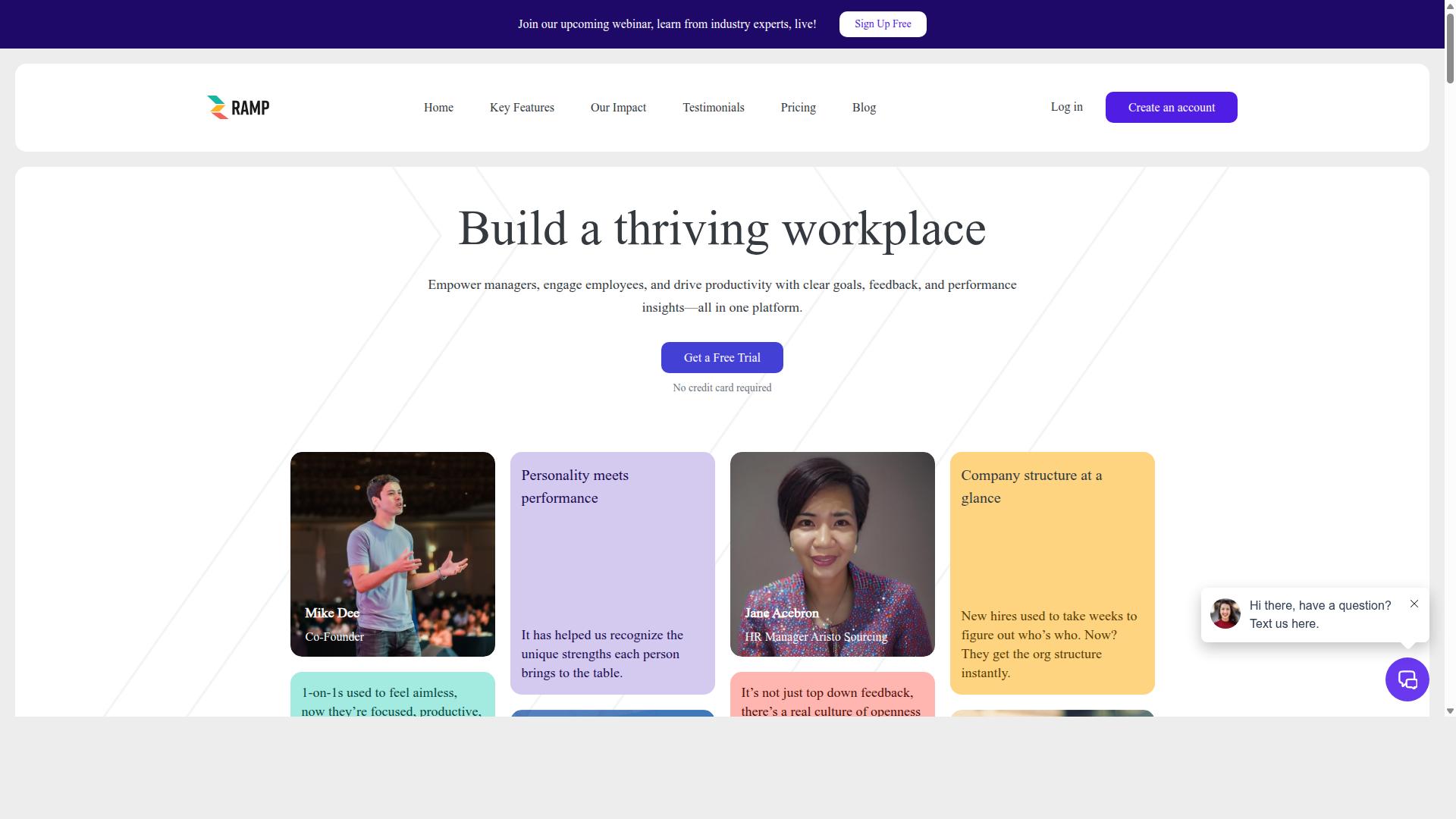
HeyRamp stands out as the best overall Lattice alternative due to its comprehensive feature set, transparent pricing, and focus on engagement. It combines performance management, employee engagement, and team development into a single platform. This makes it a strong choice for HR software buyers who want to replace multiple tools with one system.
Built for global teams, HeyRamp is trusted by 20+ organizations across different industries. The platform covers the full spectrum of talent management, from daily feedback to formal performance reviews. Its design prioritizes usability, so teams can adopt it quickly without extensive training.
Compared to other Lattice alternatives, HeyRamp offers a rare combination of depth and simplicity. Many platforms require add-ons or separate modules for features like OKRs or people analytics. HeyRamp bundles these capabilities together, which simplifies both budgeting and daily workflows.
All-in-One Engagement and Goal Tools
HeyRamp offers a suite of integrated tools that cover everything from 1-on-1 meetings to goal alignment, ensuring no aspect of performance management is overlooked. The platform includes company structure visualization, which helps teams understand reporting lines and collaboration patterns. This org chart software functionality supports workforce planning and organizational network analysis.
For managers, the 1-on-1 meeting tools include organized agendas and action tracking. This means every conversation has a clear purpose and follow-through. Guided conversation templates and coaching tips help managers lead productive discussions, even if they are new to leadership roles.
Performance reviews and feedback tools work alongside OKR and goal management with real-time progress visualization. Managers can track individual contributions against company objectives. KPI snapshots and people analytics dashboards provide leadership insights without requiring a separate workforce analytics tool.
The platform also includes personality insights and testing, sentiment prompts, and automated reminders. Confidential manager notes allow for private observations. Built-in training videos cover 1-on-1s, performance reviews, and personality testing, so teams learn best practices as they use the software.
Flat-Rate Pricing and Built-In Training
HeyRamp's flat-rate pricing and included training resources make it a cost-effective and user-friendly choice for organizations of all sizes. The platform costs $5.00 per seat monthly or $3.00 per seat when paid annually. This transparent model avoids the surprise fees common with per-feature pricing in other HR software.
A 14-day trial with no credit card required gives teams full access from day one. This allows potential customers to explore every feature before committing. You can switch plans anytime, which adds flexibility for growing organizations.
Built-in training reduces onboarding time significantly. Instead of scheduling separate vendor-led sessions, employees can watch short videos when they need guidance. This self-service approach is especially valuable for distributed teams across different time zones.
The platform also generates compliance documentation with time-stamped secure records. This automatic record-keeping supports succession planning and compensation management discussions. For enterprise buyers, custom pricing is available per seat, with the same flat-rate simplicity scaled to larger workforces.
2. Leapsome
Leapsome is a strong contender for organizations seeking a robust platform that integrates performance reviews with employee engagement surveys. The platform combines performance management with core HR features, making it a holistic option for companies that want to consolidate their people tools.
Its key features include 360-degree reviews, goal setting, engagement surveys, learning and development, and time tracking. Leapsome also offers absence management, so HR teams can handle multiple workflows without juggling separate systems.
Leapsome stands out for its AI-powered analysis and action plans. These tools help managers turn survey results into concrete next steps rather than leaving data sitting unused. The platform includes customizable templates and automated review cycles, which reduce the administrative burden on HR staff.
For privacy-conscious organizations, Leapsome provides anonymity filters and is ISO 27001:2022 certified. It is also GDPR and CCPA compliant, and the platform supports 38 languages, making it viable for global teams. Pricing starts at US$3 per user per month, with modular options that let companies pay only for what they need.
The analytics capabilities are a notable strength. Leapsome tracks adoption and engagement, giving HR leaders visibility into how often tools are actually used. This data helps organizations identify gaps in participation and adjust their approach accordingly.
One potential drawback is that pricing can climb for smaller teams as they add modules. While the entry-level cost is accessible, the full suite may stretch a tight budget. That makes Leapsome a better fit for mid-to-large enterprises with more flexibility in their HR software spending.
Leapsome also integrates with its own HRIS, which simplifies data flow for companies already using its ecosystem. However, teams with an established HRIS may need to consider how well the platform connects with their existing stack. Overall, Leapsome is a solid choice for organizations prioritizing feedback, development, and engagement in one unified system.
3. 15Five
15Five offers a focus on continuous performance management and employee development, making it a popular choice for modern teams. The platform is built around regular manager-employee touchpoints rather than waiting for annual review cycles. Its name reflects the core idea that a short, 15-minute check-in can keep performance conversations moving forward every week.
The tool is an AI-powered performance management platform that supports reviews, 1-on-1s, and OKRs. It serves over 3,000 companies and more than 250,000 employees, which speaks to its traction in the mid-market space. The product suite includes Perform, Engage, Compensation, and Manager Products, along with 15Five AI for added intelligence.
Weekly check-ins are the heart of the system. Employees answer a short set of questions about wins, challenges, and priorities, and managers can respond directly in the same interface. This creates a consistent feedback loop that helps surface problems early. It also gives managers a clear window into how their direct reports are feeling and performing.
Goal setting is handled through the OKR framework. Teams can align individual objectives with company priorities, which keeps everyone pointed in the same direction. The platform also includes tools for performance reviews and engagement surveys, so it covers more than just the weekly pulse check.
One of 15Five's standout features is its coaching layer. The Kona AI Coach and AMAYA tools provide guidance to managers and employees based on the data collected in the platform. Automated workflows via 15Five Agents can also reduce the administrative burden of tracking performance tasks.
The user interface is clean and approachable, which matters when you want broad adoption across an organization. Managers do not need extensive training to run their first check-in or set up a goal. This ease of use is a major reason why small to mid-sized teams gravitate toward the platform.
However, 15Five has some limitations. Advanced analytics are not its strongest suit. While the Insights Dashboard provides useful trends, organizations looking for deep workforce planning or predictive people analytics may find the reporting layer less comprehensive than dedicated HR analytics tools. For those needs, a platform focused on workforce analytics might be a better fit.
15Five is best suited for small to mid-sized teams that want to build a strong performance culture without heavy implementation overhead. It is a solid Lattice alternative for companies that prioritize manager effectiveness, employee engagement, and retention over complex analytical modeling.
4. Culture Amp
Culture Amp is renowned for its powerful people analytics and employee engagement surveys, making it a valuable tool for data-driven HR teams. It is designed primarily for mid-market and enterprise organizations, typically those with 200 or more employees.
The platform focuses on understanding the employee experience through several key features. It offers engagement surveys, pulse surveys, and specialized questionnaires for onboarding, offboarding, and DEI initiatives. This breadth allows HR teams to capture feedback across the entire employee lifecycle.
Beyond surveys, Culture Amp includes performance management tools. Teams can run performance reviews, set goals, and facilitate continuous feedback and 1-on-1 conversations. The platform also provides an AI Coach feature designed to offer personalized guidance for performance and development.
The standout strength is its analytics layer. Culture Amp aggregates survey responses and performance data to deliver actionable insights. Its benchmarking capabilities allow organizations to compare their results against industry standards, which helps leaders identify specific areas for improvement rather than guessing.
However, it is not a lightweight tool. The platform requires a meaningful setup process to configure surveys, competencies, and review cycles effectively. Because of this complexity and its enterprise focus, it often works best for larger organizations with dedicated HR operations teams.
For teams comparing Lattice alternatives, Culture Amp is a strong contender if employee engagement measurement is the top priority. It is less suited for smaller companies that need a quick, out-of-the-box solution, as the pricing is not publicly listed and typically involves a sales cycle. It pairs well with existing HRIS systems but may require more effort to implement than simpler performance management tools.
5. Perdoo
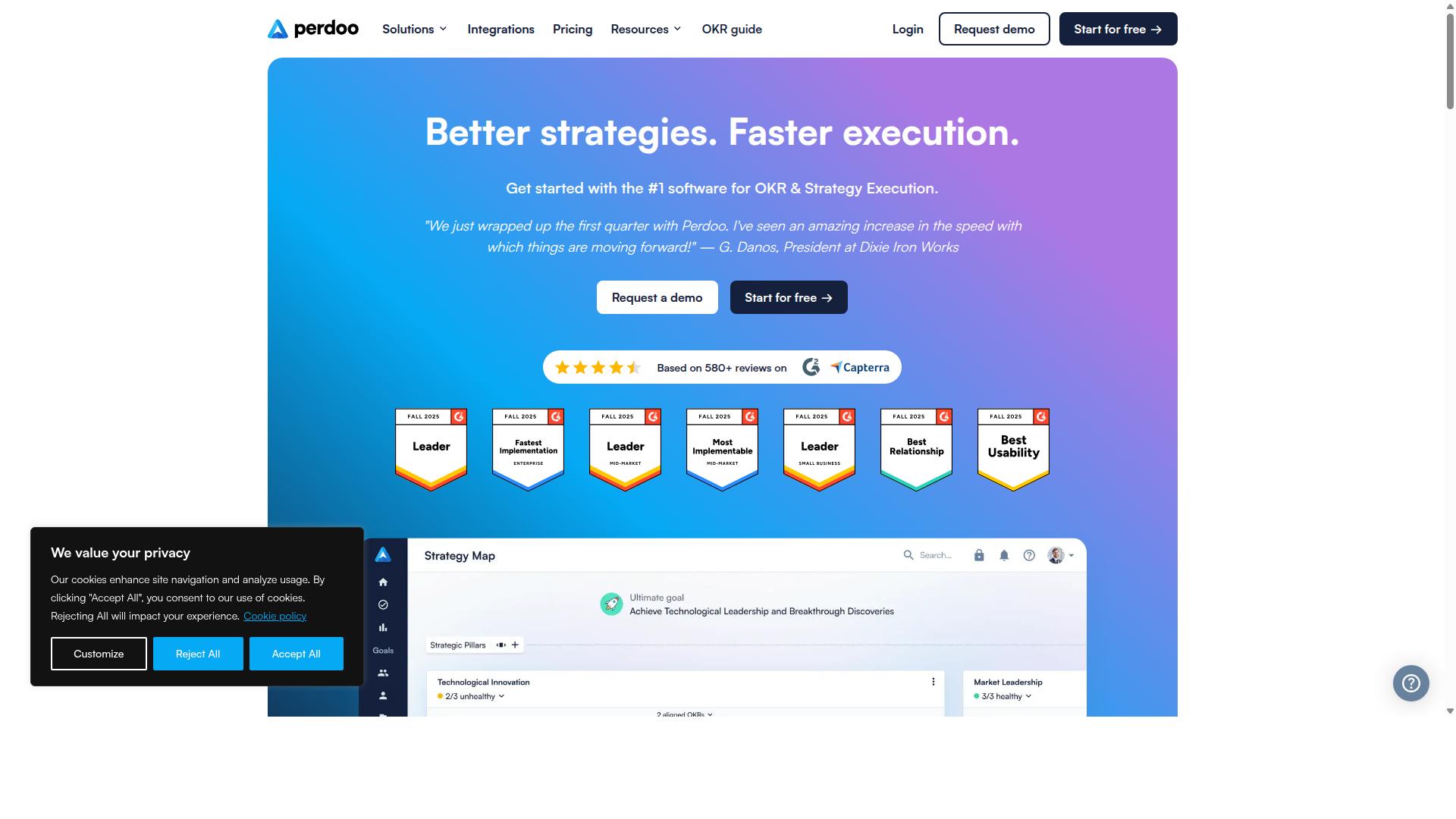
Perdoo specializes in OKR management, making it an ideal choice for organizations that prioritize goal alignment and strategic execution. The platform brings strategy, goals, and performance together in one place, so teams can connect daily work to broader company objectives.
Perdoo's core strengths lie in its goal-setting and tracking tools. Users can define objectives and key results, align them across departments, and monitor progress through clear dashboards and reports. The interface is straightforward, which appeals to teams that want a focused OKR tool without unnecessary complexity.
For goal-driven teams, Perdoo offers a structured approach that keeps everyone moving in the same direction. Its strategy map and initiative tracking features help leaders visualize how individual efforts contribute to larger priorities. This clarity is especially valuable for organizations undergoing strategic planning cycles or rapid growth.
However, Perdoo is not a full performance management suite. It lacks the broader features found in Lattice, such as performance reviews, employee engagement surveys, and development planning. Teams that need continuous feedback tools or talent management capabilities will likely need to pair Perdoo with another HR platform.
One practical consideration is Perdoo's pricing structure. Public reviews indicate a 10-seat minimum on paid plans with per-user pricing around EUR8 per month, which can become costly for larger organizations. Budget-conscious teams should factor this in when comparing Perdoo against other Lattice alternatives.
Perdoo works best for companies that have already adopted OKR methodology and want a dedicated tool to support it. If your organization also needs performance reviews, employee engagement tracking, or career pathing features, you will need to build a stack that combines Perdoo with complementary HR software.
6. Betterworks
Betterworks provides an integrated platform for performance management and OKR tracking, catering to enterprises seeking a comprehensive solution. It combines continuous performance management with goal-setting capabilities, positioning itself as a strong alternative to Lattice for organizations that want both functions under one roof.
The platform emphasizes continuous performance management, moving away from annual reviews toward ongoing check-ins and real-time feedback. Managers can track progress against objectives while employees receive regular guidance, which helps keep teams aligned throughout the year rather than waiting for a single review cycle.
OKR software is a core strength of Betterworks. The tool supports goal setting at every level, from company-wide objectives down to individual key results. This structure makes it easier for leadership to communicate priorities and for teams to see how their daily work connects to larger business outcomes.
Beyond performance and goals, Betterworks includes features for employee engagement. Pulse surveys and feedback tools give HR teams visibility into sentiment and morale, allowing them to spot issues before they escalate. This combination of performance data and engagement insights can support broader people analytics efforts.
Scalability is a key selling point for this platform. Betterworks is built for large organizations with complex structures, offering enterprise-grade security and administrative controls. For companies operating across multiple regions or business units, the platform can accommodate diverse workflows while maintaining centralized oversight.
That said, potential complexity is worth noting. The breadth of features means there is a learning curve, and implementation may require dedicated resources. Higher cost is another consideration, as enterprise-level pricing typically reflects the platform's extensive capabilities.
Betterworks is best suited for large organizations that need a unified system for performance management, OKRs, and engagement. Mid-sized companies or those with simpler processes may find the platform more than they need, particularly if they are looking for a lighter-weight solution.
For teams evaluating Lattice alternatives, Betterworks deserves attention when organizational scale and governance requirements are top priorities. It offers a robust, integrated approach, though buyers should weigh the complexity and investment against their actual needs.
7. Workboard
Workboard focuses on business execution and OKR alignment, providing a simple yet powerful tool for tracking goals and outcomes. It is designed primarily for large enterprises that want to connect daily work with company-wide objectives. The platform emphasizes visibility, helping teams see how their efforts contribute to the bigger picture.
Workboard offers OKR tracking, check-ins, and performance analytics in a single interface. Its visual dashboards make it easy to monitor progress at a glance, which reduces the time teams spend on status updates. The check-in process is straightforward, encouraging regular communication without adding excessive administrative burden.
One standout feature is its AI-powered business review summaries. These summaries help leaders digest large amounts of progress data quickly. For organizations already committed to the OKR framework, this capability can save considerable time during quarterly reviews.
However, Workboard may not offer as deep performance review features as other alternatives to Lattice. Its focus leans heavily toward goal management rather than the full talent management cycle. Teams looking for robust review cycles, development plans, or compensation tools might find the feature set limited.
Workboard is best suited for large enterprises that heavily use OKRs and want a dedicated tool for that purpose. Its interface has been described as dated, and pricing is not publicly listed, which can complicate the evaluation process. Estimates suggest a cost of around $50 per user, but interested teams should contact the vendor for accurate quotes.
In a review of 27 OKR tools, Workboard received a rating of three out of five stars. That rating reflects its solid goal-tracking capabilities alongside some usability and transparency concerns. For organizations prioritizing OKR alignment above all else, Workboard remains a credible option worth considering.
How to Choose the Right Option
Selecting the right Lattice alternative depends on your organization's specific needs, size, and strategic goals. Before comparing feature lists, take time to document the friction points that are pushing you away from your current solution.
Start by assessing your current pain points. Are performance reviews too infrequent or too rigid? Is employee engagement data scattered across spreadsheets? Do managers struggle to connect daily work with broader company objectives? Write these concerns down and rank them by urgency.
Next, list your must-have features. For most organizations, core needs include performance management, goal setting, and feedback tools. But you should also consider secondary capabilities like succession planning, compensation management, and workforce analytics depending on your HR maturity.
Involve key stakeholders early in the process. HR leaders care about data integrity and reporting. Line managers need simplicity and speed. Employees want transparency and clarity around career pathing. Each group will use the tool differently, so their input matters.
Run structured demos and request trial access for a small pilot group. Collect feedback on usability, adoption likelihood, and whether the tool actually reduces administrative burden. Research suggests that tools fail when they are chosen by one department in isolation.
Budget constraints are real, but compare total cost of ownership, not just license fees. Factor in implementation time, training needs, and whether the platform scales as headcount grows. A cheaper tool that requires constant manual work may cost more in the long run.
Scalability deserves special attention. A startup with 50 employees has different needs than an enterprise with 5,000. Startups often prioritize speed and simplicity, while larger organizations need robust HRIS integration and advanced data visualization.
Consider your organization type with these guidelines in mind:
- Startups: Look for lightweight tools with quick setup, intuitive interfaces, and flexible goal setting. Avoid platforms with heavy configuration requirements that slow down early adoption.
- SMEs: Balance functionality with ease of use. You likely need performance reviews, employee development, and engagement surveys without enterprise-level complexity.
- Enterprises: Prioritize integration depth, security controls, and the ability to support multiple departments with different workflows. Organizational network analysis and workforce planning become more relevant at this scale.
For organizations seeking improved performance management, employee engagement, and goal alignment, platforms like HeyRamp serve leadership, line managers, HR, and individual contributors alike. Its focus on team development makes it a practical fit for companies that want continuous improvement without heavy administrative overhead.
Finally, create a shortlist of three to five tools and score them against your documented requirements. Include categories like performance reviews, OKR software, employee engagement, and succession planning. Weight each category according to your strategic priorities.
Remember that the best alternative is not the most popular one, but the one that fits your culture and workflow. Take time to validate assumptions with real users, and revisit your decision after six months to confirm the tool delivers the expected outcomes.
Final Verdict
After evaluating the top alternatives, HeyRamp emerges as the best overall choice for most organizations seeking a balanced, cost-effective solution. The platform combines performance management, employee engagement, and people analytics into one unified system. That breadth matters when you compare it against tools that excel in only one area, such as org chart software or dedicated engagement surveys.
HeyRamp's one flat fee pricing removes the guesswork that comes with per-seat or per-module costs. Many competitors, including Lattice and Culture Amp, structure pricing around add-ons and tiers. With HeyRamp, you get the all-in-one features without worrying about surprise expenses as your team grows.
The platform is trusted by 20+ organizations and 400+ teams, which signals real-world reliability across different company sizes. Built-in training and education set it apart from alternatives that leave you to figure out implementation on your own. Automatic compliance documentation also reduces the administrative burden that HR teams typically carry.
For managers, HeyRamp offers instant coaching tips and automated reminders, along with guided conversation templates for difficult discussions. These features directly address the pain points that performance management tools often overlook. Personality insights integrated with performance tools help leaders understand their teams while aggregated people analytics dashboards provide a clear view of organizational health.
When you weigh the options, most alternatives require you to piece together separate solutions for reviews, goals, and analytics. HeyRamp consolidates these into a single platform with predictable pricing and built-in support. That combination makes it the strongest candidate for organizations that want results without complexity.
We encourage you to explore HeyRamp through its free trial to see how it fits your workflow. Visit HeyRamp's website for more information on features, pricing, and implementation. The right people management tool should simplify your processes, and HeyRamp delivers on that promise.
Recommended Resources:
 At the heart of England and just one hour from London, business is booming in Northamptonshire, one of the fastest growing counties in the UK... and recently named


